
Iron (Mars)
Iron (Mars), Latin Ferrum, is the martial metal of Renaissance chymistry, written ♂ and later identified as Fe.
♂ · Chem: Fe- Chymical Order
- III · Seven Planetary Metals
- Latin Term
- Ferrum / Mars
- Unicode
- U+2642
- Modern Chemistry
- Fe
- Planetary Sphere
- Mars
- Magnum Opus Stage
- Calcinatio
In the technical vocabulary of early modern chymistry, iron is Ferrum, ruled by Mars and written with the male sign ♂ (U+2642). The figure joins a circle to an oblique arrow, encoding heat, hardness, and martial virtue. Operators handled it as a laboratory metal and as a planetary signature within the Magnum Opus, especially under the regimen of calcinatio.
I.Glyph Geometry, Unicode & Scribal Variants
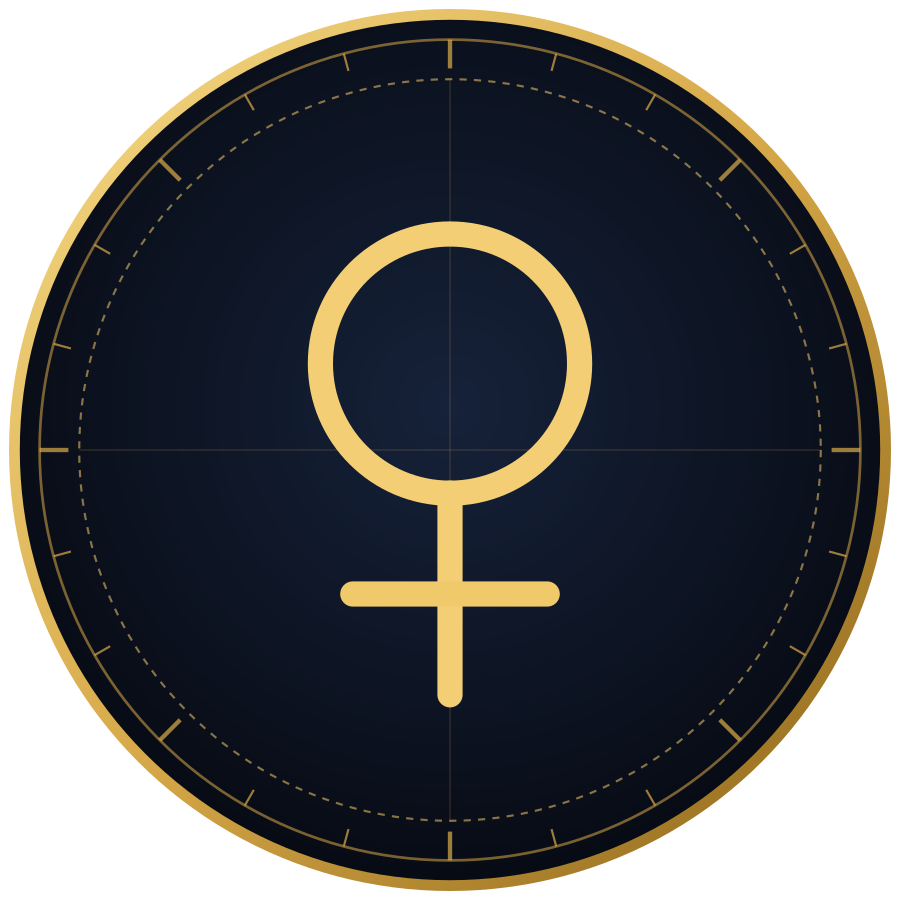
The Mars glyph ♂ comprises a closed circle, the usual mark of a planetary metal, and an arrow leaving the circle's upper-right and pointing northeast, commonly near forty-five degrees, with a short barbed head. In Newton's chymical papers the circle is often slightly flattened and the shaft nearly vertical when the line is crowded. Gessmann's classification of medieval sigla places Ferrum with Mars and notes variants in which the arrow is detached, doubled, or reduced to a diagonal. The sign is distinct from Venus ♀, whose cross depends beneath the circle, from the Sagittarius arrow, and from crosses or daggers used for vinegar or tartar. Unicode records the traditional form as U+2642; the alchemical block from U+1F700 adds related ore and regulus signs without displacing this martial glyph.
II.Laboratory Chymistry & Material Properties
Assayers recognized iron by its grey fracture, high melting point, and magnetism once the metal was reduced. Principal ores—hematite, magnetite, and pyrites—were roasted or calcined, then reduced with charcoal in a bloomery or later a blast furnace. Strong fire raises a hard scale; the calx, largely ferric oxide, is red-brown and difficult to fuse. Aqua fortis or oil of vitriol gives green or yellow liquors that crystallize as copperas, ferrous sulfate, long used in dyeing and medicine. A martial regulus made with antimony was a chymical product distinct from smith's bar iron. Filings, hammer scale, and crocus Martis were weighed, washed, and reverberated; practitioners noted color, loss on calcination, and restoration of metal when the calx met charcoal. Such notes record workshop fact, not merely emblem.
III.Hermetic Correspondence & Planetary Doctrine
Under the planetary scheme inherited from late antique and Arabic natural philosophy, iron belongs to Mars: hot, dry, and choleric, opposed to the cold moisture of Venus and to the lunar quality of silver. Aristotelian theory classes it as a fusible earthy metal generated in the mine under a martial influx; Paracelsian writers recast that influx as an astral semina impressed on a sulfurous and saline matrix. The arrow of ♂ signifies projection, wounding, and outward fire, while the circle retains the metallic perfection shared with the other six metals. Polarity is therefore double: iron is fixed and hard, yet its rust and vitriol show an active, corrosive spirit. In emblem books the armed man and the red soldier stand for this same body, fierce in calcination and serviceable once its martial excess is tempered by Venus.
IV.Historical Treatises, Papyri & Emblem Books
Greco-Egyptian technical papyri and the works associated with Zosimos already treat iron as a dye-metal and a body subject to tincture, though the later planetary canon is only partly formed. Arabic mineralogies transmitted through the Latin Geberian corpus and Albertus Magnus fix ferrum among the seven metals and assign it to Mars. Medieval recipe books describe crocus Martis, oil of iron, and the cementation of iron with copperas. Paracelsus and his editors make Mars a pillar of spagyric pharmacy: martial preparations, from crocus to tartarus Martis, are indicated for the blood and for wounds. Emblematic chymistry then stages the same metal. Michael Maier's Atalanta Fugiens (1618) and related Basilica-style image cycles set the red knight and the wolf of antimony beside iron's calcination and its conjunction with Venus.
V.Role in the Magnum Opus & Laboratory Operations
Within the Magnum Opus, iron's governing operation is calcinatio. The metal or its ore is exposed to open fire until volatile moisture and combustible sulfur depart and a fixed calx remains, classically the red crocus Martis. That calx may be reverberated for days, ground, and returned to the fire, the repetition itself being the discipline of calcination. Dissolution in a corrosive menstruum, crystallization of vitriol, and a fresh calcination form a shorter spagyric cycle that yields a soluble martial salt. In longer sequences the calx is reduced, conjoined with Venus or with antimonial sulfur, and again calcined so that the martial ferocity is said to be tamed. The operation is not a metaphor pasted onto a text: it is a thermal regime, judged by color, weight, and the refusal of the calx to melt like a metal.
VI.Transition to Modern Chemistry & Cultural Legacy
Eighteenth-century reform separated the martial emblem from the elementary substance. Lavoisier's oxygen theory recast the calx of iron as a compound of metal and oxygen rather than metal deprived of phlogiston, and the old name crocus Martis survived only as a trade term for ferric oxide. Berzelius's alphabetic notation replaced ♂ with Fe, from Latin ferrum, and aligned iron with atomic weights and definite proportions. Modern chemistry knows Fe as element 26, a first-transition metal of group 8 and the fourth most abundant element in the crust; native metallic iron arrives chiefly in meteorites. Digital encoding preserved the historical sign: U+2642 remains the male/Mars glyph, while the Alchemical Symbols block opened at U+1F700 standardizes specialist forms for ore, regulus, and related preparations.
FAQ — Iron (Mars)
What does the Iron (Mars) symbol mean in Renaissance chymistry?
The sign ♂ names the metal ferrum and the planet Mars together. It marks a hot, dry, choleric body whose laboratory face is iron, its ores, vitriol, and the red calx called crocus Martis. The same character later became the ordinary male and Mars sign outside chymical manuscripts.
How is Unicode U+2642 drawn, and how does it differ from similar signs?
U+2642 is a circle with an arrow rising from the upper right, usually near forty-five degrees and ending in a barb. Venus (♀) places a cross under the circle instead. Alchemical ore and regulus signs in the U+1F700 block are separate characters and do not replace this martial glyph.
How did historical laboratory work on iron differ from its symbolism?
Workshop practice roasted ores, reduced them with charcoal, dissolved the metal in aqua fortis or oil of vitriol, and calcined filings to a red oxide. Planetary language of Mars explained the same substance as hot, wounding, and in need of tempering. Color, weight, and fusibility were observed facts; the armed man and the wolf were readings of those facts.
References
- Wikipedia: Iron — Wikipedia Contributors (Wikimedia Foundation, 2026) · 2026-11-12The Wikipedia chemistry article documents iron as element Fe, atomic number 26, a group-8 transition metal, fourth in crustal abundance, and chiefly meteoritic in the native metallic state.
- Die Geheimsymbole der Chemie und Medicin des Mittelalters — Gustav Wilhelm Gessmann (Verlag des Verfassers (Graz / München), 1899)Gessmann's Die Geheimsymbole der Chemie und Medicin des Mittelalters (1899) classes the Ferrum/Mars sigil with planetary metal signs and records scribal variants of the circled arrow.
- The Secrets of Alchemy & Unicode Standard Block U+1F700 (Alchemical Symbols) — Lawrence M. Principe / Unicode Consortium (University of Chicago Press / ISO/IEC 10646, 2013) · 2026-11-12Unicode places the traditional Mars glyph at U+2642 and specialist alchemical signs from U+1F700, while Principe's Secrets of Alchemy treats such signs as operative laboratory notation rather than mere occult decoration.
Related

Updated: · Editor: Tabula Chymica Editorial Archive