
Tin (Jupiter)
Tin (Jupiter) is stannum (Sn), the soft planetary metal of Jupiter (♃), assigned in the Magnum Opus to the whitening work of Albedo.
♃ · Chem: Sn- Chymical Order
- III · Seven Planetary Metals
- Latin Term
- Stannum / Iuppiter
- Unicode
- U+2643
- Modern Chemistry
- Sn
- Planetary Sphere
- Jupiter
- Magnum Opus Stage
- Albedo
Tin, Latin stannum and in chymical Latin often Iuppiter, is the soft white metal later denoted Sn, bound to the planetary sphere of Jupiter and written with the sigil ♃ (U+2643). Its fusibility, cry, and bright calx made it a laboratory metal as well as a hermetic sign, placed by this tradition within the whitening work of Albedo.
I.Glyph Geometry, Unicode & Scribal Variants
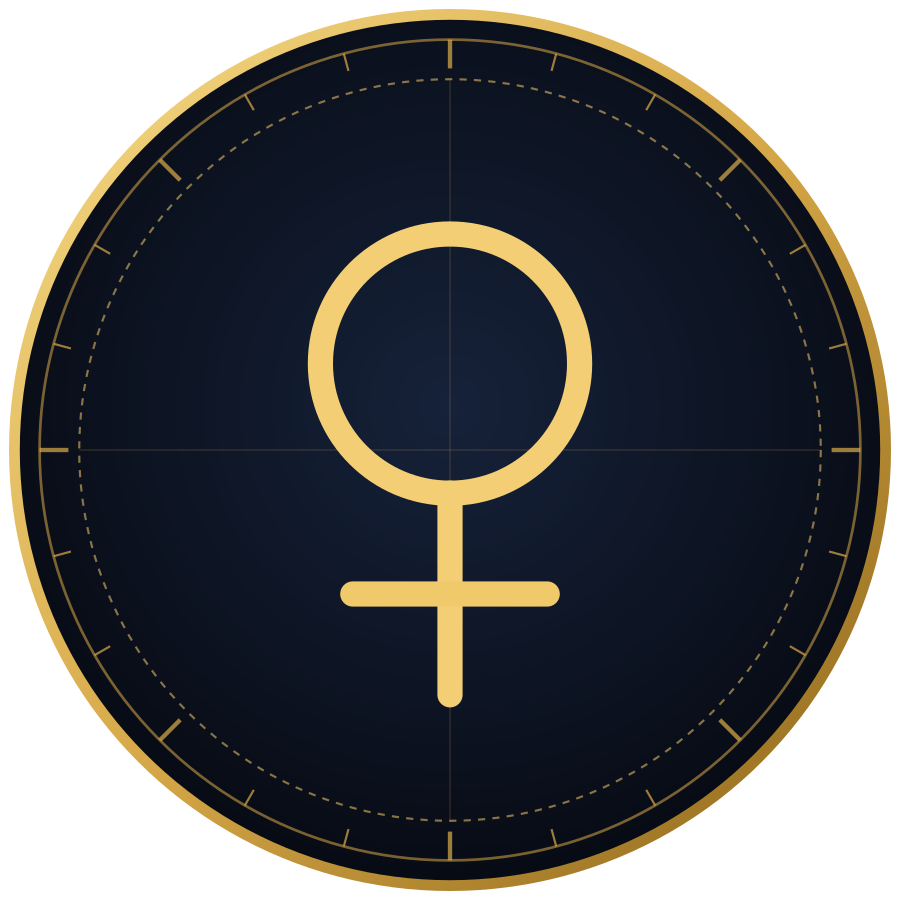
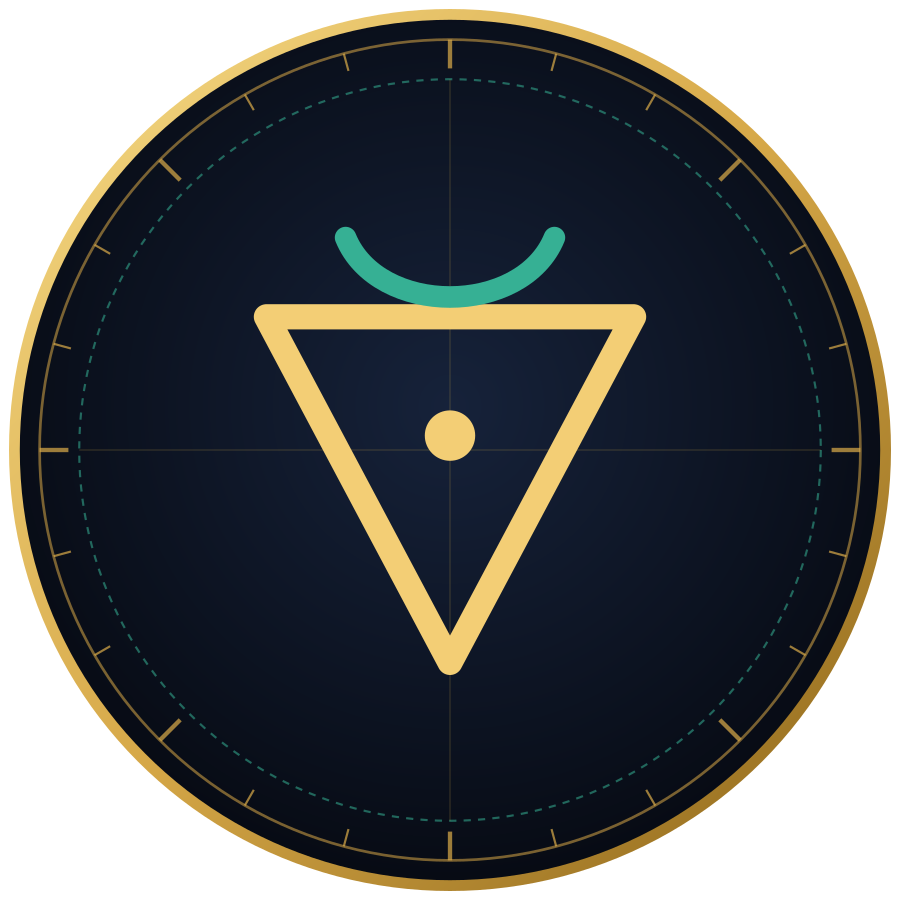
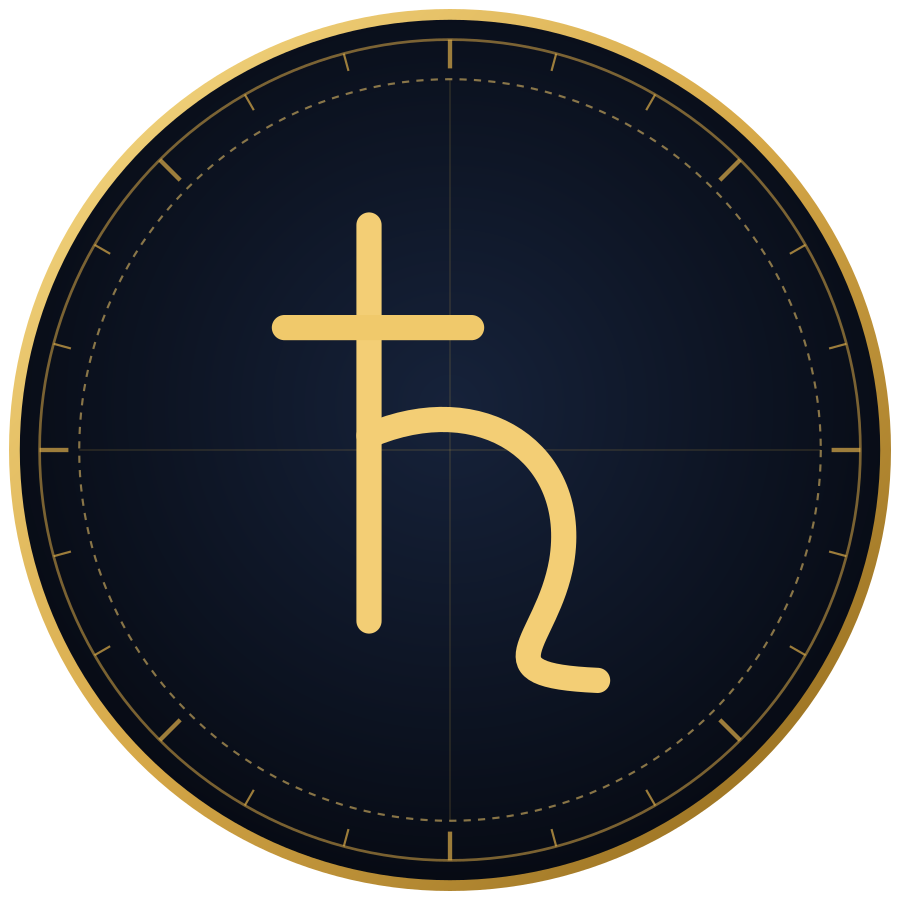
The Jupiter glyph ♃ (U+2643) joins a cross to a crescent. Standard ductus sets a Latin cross—upright stem crossed by a shorter bar—and rests upon the stem a crescent, so the figure reads as a hook above a cross rather than a circle. That geometry is the graphic opposite of Venus, ♀ (U+2640), in which a full circle surmounts the cross, and it is simpler than Mercury, ☿ (U+263F), which stacks crescent, circle, and cross. Saturn, ♄ (U+2644), inverts the relation: the cross stands above a descending curve. Scribal practice from the later Middle Ages through Newton’s chymical papers often compresses the crescent into a single curved stroke or a flat tick, and G. W. Gessmann’s tables of medieval sigils record both the canonical hooked cross for Stannum / Iuppiter and degraded forms that approach a mere cross with a barb.
II.Laboratory Chymistry & Material Properties
In the workshop, tin was identified by hand. A bar bends under slight force and, on bending, gives the cry (Latin stridor) that assayers took as the signature of stannum against lead. The metal fuses in a mild charcoal fire, and the melt runs bright and thin. Its ore is cassiterite, the dense tin stone, reduced with charcoal; alluvial tin from Cornwall and vein tin from Bohemia and Saxony fed late medieval and early modern shops. Coppersmiths united it with copper as bronze and with lead as pewter or solder. Calcination leaves a white, refractory calx, kept as a fixed white body and used to cloud glass and enamel. Tin withstands vinegar, yields slowly to aqua fortis or aqua regia, and amalgamates readily with mercury. Separation from lead relied on the cry, on easier fusion, and on the whiteness of the calx.
III.Hermetic Correspondence & Planetary Doctrine
Jupiter names both the planet and the metal. In the Aristotelian scheme tin is a fusible, watery metal, imperfect beside gold and silver because its sulfur and mercury—the two principles of the medieval metal theory—are poorly proportioned: too much volatile moisture, too little fixed heat, hence the cry and the swift melt. Paracelsian writers kept the planetary chain and a jovial triad of salt, sulfur, and mercury, assigning Jupiter to the liver. The polarity is benefic and expansive rather than martial or saturnine: where Mars is iron, hard and inflammable in its calx, and Saturn is lead, heavy and melancholic, Jupiter is generous, white-bright, and easily opened by fire. The crescent-over-cross was read as soul or volatile spirit set over the body of the four elements.
IV.Historical Treatises, Papyri & Emblem Books
Greco-Egyptian technical papyri treat tin, kassiteros, as solder and as an alloy metal distinct from lead. Zosimos and the later Greek corpus bind the seven metals to the planets, a scheme Latin Europe inherited. Arabic writers separated qalaʿī, tin, from usrūb, lead; Latin versions gave stannum and plumbum, yet plumbum album could still mean tin and confuse recipes. The Summa perfectionis, under the name Geber, calls tin immature: its cry shows enclosed air or poorly digested mercury. Paracelsian books repeat the Jovial link in discussions of metallic arcana. Maier’s Atalanta Fugiens (1618) sets the planetary metals in emblem and epigram; Jupiter’s body is one to calcine, wash, and recombine. Gessmann’s lexicon files the manuscript forms under Stannum and Iuppiter, evidence that the hooked cross was stable by the seventeenth century.
V.Role in the Magnum Opus & Laboratory Operations
Within the Magnum Opus, tin is stationed at Albedo, the whitening that follows the black putrefaction. Operators sought a fixed white earth: the calx of tin, patient and refractory after the metal’s easy fusion, offered a visible white body that could be washed, reverberated, and returned to a regulus. In practical sequence the metal might be calcined alone, or dissolved and precipitated, until the cry of the crude bar gave way to a silent powder. That powder was not yet Luna, nor the Stone, but a jovial white able to enter conjunctions aimed at silvering or at cleansing a blackened mass. Some laboratory books use tin as a flux or a cement in the whitening of other calces; others sublime chlorides or butyrum-like preparations and then sweeten them back to a white salt.
VI.Transition to Modern Chemistry & Cultural Legacy
Eighteenth-century reform stripped the sigil of its planetary office. Lavoisier’s nomenclature treated tin as a simple metallic substance forming calces—oxides—rather than as immature gold. Berzelius and his successors fixed the abbreviation Sn, from Latin stannum, in the elemental notation still used. The soft gray metal, atomic number 50, is the element whose bar can be cut or bent by hand; the cry is now explained by twinning in the crystals of white tin. Gray tin and the pest that crumbles the white metal are modern solid-state facts, not chymical signatures. Unicode registers the historical Jupiter sign at U+2643 and, from Unicode 6.0, a separate Alchemical Symbols block beginning at U+1F700 for the wider manuscript repertoire.
FAQ — Tin (Jupiter)
What does the Tin (Jupiter) symbol mean in chymical texts?
The sigil ♃ marks both the planet Jupiter and the metal tin (stannum). In recipes and emblems it instructs the operator to take metallic tin, or a preparation made from it, under Jovial correspondence rather than lead, silver, or iron.
How is Unicode U+2643 drawn, and how does it differ from similar signs?
U+2643 is a cross topped by a crescent or open hook, not by a circle. Venus places a circle on the cross, Mars an arrow, and Saturn a cross over a curve. A hasty Jupiter can resemble Mars if the crescent collapses into a single barb.
Did laboratory work with tin match its Jupiter symbolism?
Assayers did bend, melt, and calcine tin, and they used the cry and the white calx to tell it from lead. The planetary name ordered those operations; it did not replace the furnace, and the white calx was not itself the Stone.
References
- Wikipedia: Tin — Wikipedia Contributors (Wikimedia Foundation, 2026) · 2026-11-12The Wikipedia summary documents tin as element Sn, a soft gray metal that can be bent by hand and that emits the so-called tin cry when its crystals twin.
- Die Geheimsymbole der Chemie und Medicin des Mittelalters — Gustav Wilhelm Gessmann (Verlag des Verfassers (Graz / München), 1899)Gessmann’s Die Geheimsymbole der Chemie und Medicin des Mittelalters (1899) classes the hooked cross among the manuscript sigils for Stannum and Iuppiter.
- The Secrets of Alchemy & Unicode Standard Block U+1F700 (Alchemical Symbols) — Lawrence M. Principe / Unicode Consortium (University of Chicago Press / ISO/IEC 10646, 2013) · 2026-11-12Unicode places the Jupiter sign at U+2643 and gathers further alchemical signs from U+1F700, while Lawrence Principe’s history of alchemy treats the tin–Jupiter link as part of early modern chymical practice.
Related
Updated: · Editor: Tabula Chymica Editorial Archive