
Philosopher's Stone (Lapis)
Mythic chymical agent, the Lapis Philosophorum, held to transmute base metals into gold or silver and to yield an elixir of life.
🜚 · Chem: Squared Circle ( Chrysopoeia )- Chymical Order
- V · Operations & Magnum Opus
- Latin Term
- Lapis Philosophorum
- Unicode
- U+1F71A
- Modern Chemistry
- Squared Circle ( Chrysopoeia )
- Planetary Sphere
- Sol Perfectus
- Magnum Opus Stage
- Rubedo
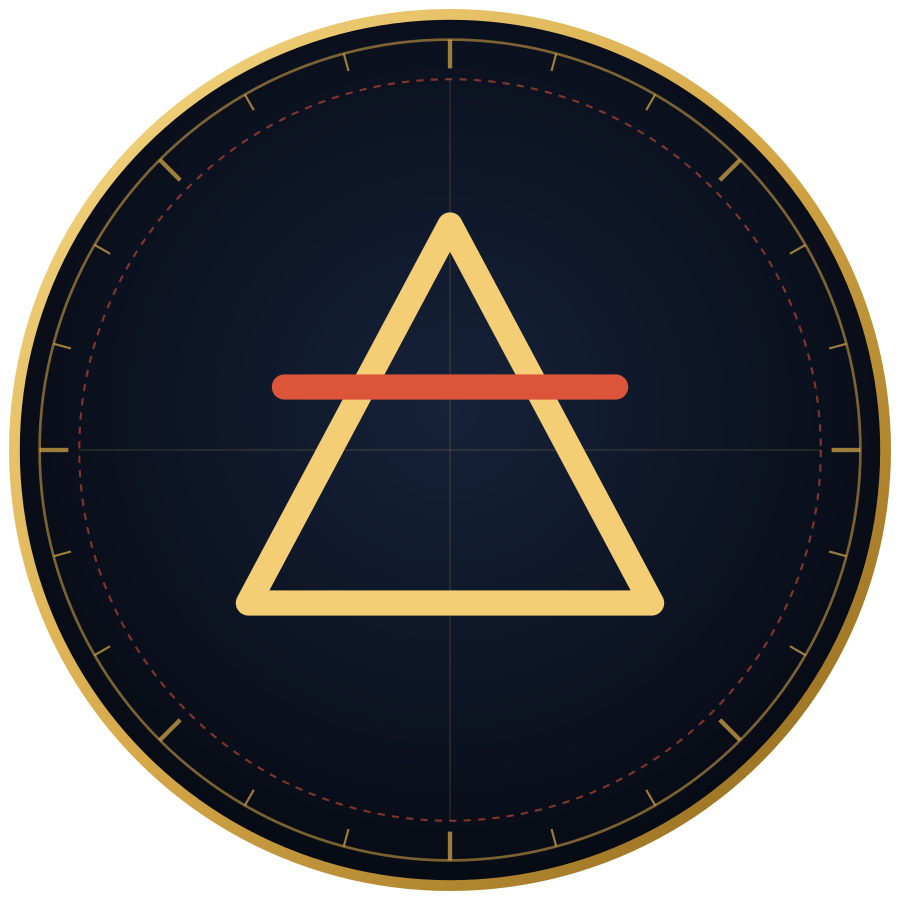
The philosopher's stone (Latin Lapis Philosophorum), encoded as 🜚 (U+1F71A), names the perfected agent of chrysopoeia: a tincture or powder—red lion for gold, white lion for silver—by which base metals were held to become noble and the body to be rejuvenated. Its geometry condenses the squared circle of the Great Work under Sol Perfectus.
I.Glyph Geometry, Unicode & Scribal Variants
The code point U+1F71A draws a closed ring whose interior is articulated by a cruciform: a horizontal diameter crossed by a vertical that meets the circumference, the whole read in early modern hands as a compacted squared circle rather than as a planetary disc. Stroke order in scribal practice is ring first, then the cross, so the circle remains the containing term and the cross the operative intersection of axes. Isaac Newton's laboratory notebooks and the plates gathered by G. W. Gessmann in Die Geheimsymbole der Chemie und Medicin des Mittelalters (1899) show looser variants: a circle set in a square, a triangle nesting both, or a small pellet on the cross-arm standing for the red tincture. These are not interchangeable with lookalikes. Salt (often a circle cut by one horizontal) lacks the full cross; Sol is a ring with a central dot and no diametral arms; the antimony regulus and vitriol monograms add serifs or letters the lapis sign refuses. Printers of the Unicode Alchemical Symbols block normalized those manuscript differences into one glyph so that 🜚 could be distinguished in plain text from both ☉ and the salt ring.
II.Laboratory Chymistry & Material Properties
In the laboratory the lapis was never a single mineral species but the name given to a prepared powder or tincture obtained at the end of a long sequence of calcinations, dissolutions, and cohobations. Practitioners worked with glass cucurbits, alembics, pelicans, and sealed philosophers' eggs set in sand or ash baths, judging heat by the color of the vessel rather than by a thermometer. Assaying behavior was the practical test of chrysopoeia, the squared circle of the art: a minute portion of the red powder, projected onto molten lead, tin, or mercury in a cupel or crucible, was expected to fix the mass as gold that would survive cementation and touchstone trial; the white preparation was likewise aimed at silver. Mineral starting points commonly included vitriols, martial crocus, antimonial glass, and carefully purified mercury, not native gold. Observers recorded weight gain or loss, a glassy fracture, a scarlet or citrine surface, and resistance to ordinary aqua fortis. Lawrence Principe and William R. Newman have shown that such operations were genuine metallurgical experiments pursued under allegorical names, not mere spiritual metaphor detached from the fire.
III.Hermetic Correspondence & Planetary Doctrine
Planetary assignment places the finished stone under Sol Perfectus, the sun no longer as crude gold but as the reconciled metal in which hot, dry solar virtue has been fixed without loss of subtlety. Aristotelian matter theory supplied the grammar: the lapis was said to alter the substantial form of a base metal by imposing a nobler form through a minimal agent, the mass of the projection far exceeding the mass of the powder. Paracelsian chymistry recast that claim in terms of tria prima—salt, sulfur, and mercury—so that the stone became the exalted sulfur of the metals, able to dye and to heal. Symbolic polarity runs through the literature as red against white, king against queen, fire against dew: solar heat perfected, lunar moisture subordinated rather than erased. The polarity is operational as well as rhetorical. White work precedes red; moisture must be disciplined before the last fixation. The stone is therefore both product and agent, the term in which opposite qualities are held without returning to chaos.
IV.Historical Treatises, Papyri & Emblem Books
Greco-Egyptian technical papyri and the writings associated with Zosimos of Panopolis already speak of a tincture and of a divine water that colors metals, though they do not yet fix the Latin name Lapis Philosophorum. Arabic treatises transmitted through the twelfth century, among them materials later pinned to Jabir and to the Turba philosophorum, gave Latin Europe the vocabulary of elixir, projection, and the red and white stones. Medieval Latin summae and image-cycles—Aurora consurgens, the Ripley Scrolls, and countless recipe books—diagram the work as a sequence of vessels and colors. Paracelsus and his editors relocated the stone inside a medical chymistry of arcana, while the Rosicrucian and courtly emblem tradition, notably Michael Maier's Atalanta Fugiens (1618) with its epigrams and fugues, staged the same claims as public enigmas. Basilica philosophica and related florilegia compile earlier authorities rather than report a single laboratory. Across this corpus the stone remains a textual object as much as a powder: each manuscript both promises a replicable operation and withholds the decisive proportions.
V.Role in the Magnum Opus & Laboratory Operations
Within the Magnum Opus the lapis belongs to Rubedo, the red stage after nigredo and albedo. Earlier colors mark dissolution and washing; rubedo marks the moment when the red sulfur is fixed, multiplied, and judged fit for projection. Laboratory sequences that claim this end typically alternate solve and coagula: the matter is opened by a corrosive or by its own inner mercury, washed to whiteness, then digested under a regulated fire until a citrine and finally a scarlet powder appears. Multiplication, when asserted, consists in feeding that powder with fresh mercury so that its tinging power increases. Fermentation joins a portion of the stone to prepared gold, on the theory that like perfects like. Rubedo is therefore not a mood but a terminal regime of heat and fixation. Failure was read in the vessel—blackness returning, glass bursting, a volatile sublimate instead of a heavy powder—and success only in the assay that followed.
VI.Transition to Modern Chemistry & Cultural Legacy
Lavoisier's oxygen theory and the gravimetric habits of the late eighteenth century removed the conceptual space in which a minute powder could impose a new metallic form without measurable exchange of constituents. Berzelius and his contemporaries then replaced alchemical monograms with letter formulas, so that gold became Au and the old glyphs survived only as historical signs. What early modern chymists called the squared circle of chrysopoeia is now described, when the experiments can be reconstructed, as attempted purifications, alloyings, and color changes in lead, mercury, and antimony matrices—not as elemental transmutation, which requires nuclear change far outside the furnace. The Unicode block U+1F700–U+1F77F, informed by Newton's manuscripts and by Gessmann's plates, restored 🜚 (U+1F71A) as a character for scholarship and editing, not as a reagent. The sign now indexes a historical practice whose laboratory ambitions and philosophical claims must be kept distinct from modern elemental chemistry.
FAQ — Philosopher's Stone (Lapis)
What does the Philosopher's Stone (Lapis Philosophorum) signify in chymical texts?
It names the perfected tincture or powder of chrysopoeia, called red lion when aimed at gold and white lion when aimed at silver. Authors also credit it with an elixir said to rejuvenate the body. The same word covers both the laboratory product and the goal of the Great Work.
How is Unicode U+1F71A (🜚) drawn, and how does it differ from similar signs?
The standard glyph is a circle crossed by horizontal and vertical arms that meet the ring, a compact squared-circle form. It is not the solar disc with a central dot, nor the salt sign reduced to a single horizontal bar. Manuscript variants add a surrounding square or triangle; the Unicode form fixes one of those traditions.
Was the stone only a symbol, or did it name laboratory operations?
Both. Emblem books allegorize it, yet practitioners also calcined, dissolved, and assayed real minerals in glass vessels and cupels. Historical scholarship treats the allegorical language and the metallurgical trials as parts of one enterprise, not as poetry substituted for work at the furnace.
References
- Wikipedia: Philosopher's stone — Wikipedia Contributors (Wikimedia Foundation, 2026) · 2026-11-12The Wikipedia article documents the philosopher's stone as a mythic substance for metallic transmutation and for an elixir of life, under the names tincture, powder, red lion, and white lion.
- Die Geheimsymbole der Chemie und Medicin des Mittelalters — Gustav Wilhelm Gessmann (Verlag des Verfassers (Graz / München), 1899)Gessmann's Die Geheimsymbole der Chemie und Medicin des Mittelalters (1899) classifies Lapis Philosophorum among early modern Geheimsymbole, recording cruciform and squared-circle variants used for the stone.
- The Secrets of Alchemy & Unicode Standard Block U+1F700 (Alchemical Symbols) — Lawrence M. Principe / Unicode Consortium (University of Chicago Press / ISO/IEC 10646, 2013) · 2026-11-12Unicode U+1F71A, in the U+1F700 alchemical block, standardizes the lapis sign, while Lawrence Principe's Secrets of Alchemy situates the stone in experimental chrysopoeia rather than in later occult caricature.
Related




Updated: · Editor: Tabula Chymica Editorial Archive