
Rebis (Coniunctio Oppositorum)
The Rebis is the hermaphroditic res bina of Sol and Luna, the coincidentia oppositorum marking coniunctio in the magnum opus.
🝰 · Chem: Coincidentia Oppositorum- Chymical Order
- V · Operations & Magnum Opus
- Latin Term
- Res Bina (Sol et Luna)
- Unicode
- U+1F770
- Modern Chemistry
- Coincidentia Oppositorum
- Planetary Sphere
- Sol + Luna + Mercurius
- Magnum Opus Stage
- Coniunctio
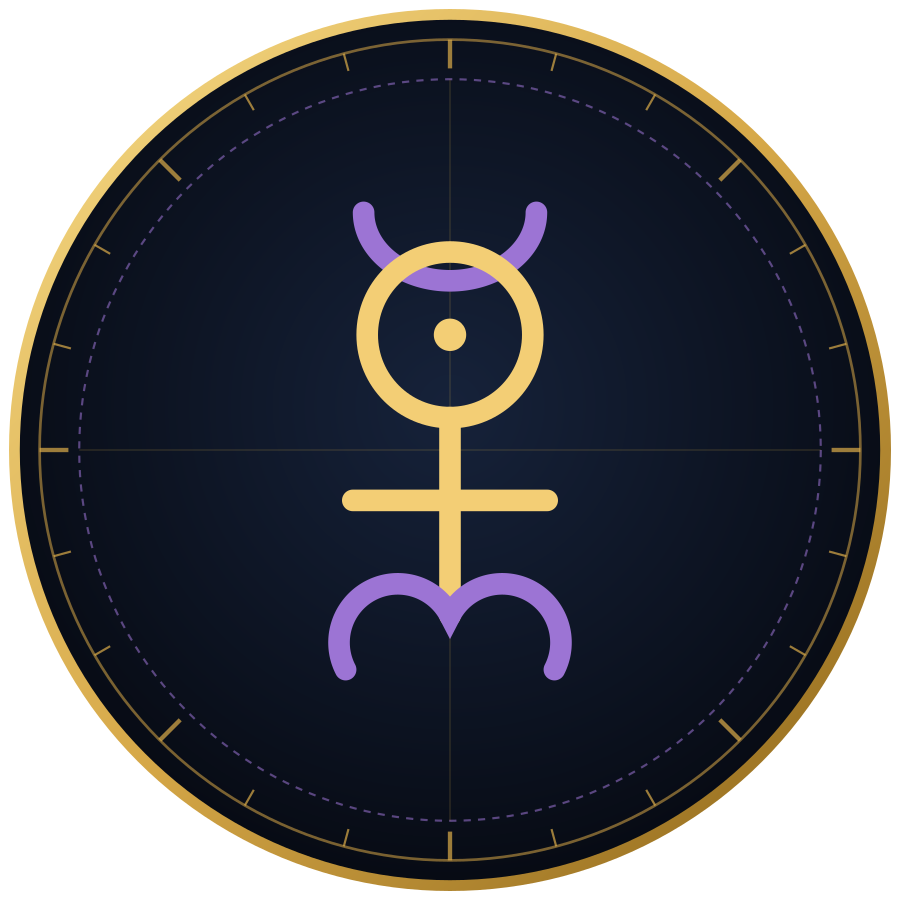
Rebis, Latin res bina, names the double thing in which solar and lunar natures stand as one body. Its sign 🝰 (U+1F770) joins opposed strokes into a single figure of coniunctio. In Renaissance chymistry the image marks both the androgyne sought at the end of the magnum opus and, in some readings, the undivided prima materia from which that work begins.
I.Glyph Geometry, Unicode & Scribal Variants
The glyph 🝰 (U+1F770) joins a vertical stem, a short crossbar, and a triangular crown on a broad foot. Read as Rebis, the crown is Sol, the foot Luna, and the cross Mercurius. Hands usually draw stem, bar, then two obliques, a sequence easily mistaken for the sublimation wedge or a clipped mercury monogram. Newton's chymical notes keep the figure spare, with the pen lifted between stem and crown. Gessmann's Die Geheimsymbole der Chemie und Medicin des Mittelalters (1899) places double-nature sigla with res bina, apart from the solar circle-and-dot and the lone crescent. Antimony's cross and seriffed vitriol marks are the chief lookalikes; at small size their extra ticks vanish. A true Rebis keeps sun and moon as coequal parts of one body.
II.Laboratory Chymistry & Material Properties
In the laboratory the Rebis was not a single ore but a claimed state of matter in which fixed and volatile bodies had been brought to one mass. Practitioners spoke of coincidentia oppositorum when gold and silver, worked with a mercurial medium, ceased to separate under washing or cupellation. The hardware was ordinary assaying gear: the crucible, the cupel, the alembic, the pelican, and the sealed philosophical egg in a sand bath or athanor. Starting points included native gold and silver and mercurial amalgams. Observers recorded loss of distinct metallic luster, a pasty intermediate, and a later compact regulus that resisted simple parting. Black, white, and red stages were read as signs that opposition had become one substance, alloy or amalgam or theory over incomplete fusion.
III.Hermetic Correspondence & Planetary Doctrine
Planetary assignment places the Rebis under Sol, Luna, and Mercurius together. Sol supplies form, heat, and the masculine pole; Luna supplies matter, moisture, and the feminine pole; Mercurius is the fugitive medium in which those poles can meet without either being erased. Aristotelian matter theory supplies hot, cold, moist, and dry, and act and potency: the double thing remains when contrary qualities no longer stand as separable substances. Paracelsian chymistry recasts the polarity in the tria prima, sulphur and salt toward solar fixity, mercury toward lunar volatility, reconciled in one body. King and queen, red and white, sun and moon name opposed regimens, calcination against dissolution, pictured as an androgyne. The hermaphrodite holds difference inside one substance.
IV.Historical Treatises, Papyri & Emblem Books
The double-bodied ideal has roots in late antique metallurgical allegory. Zosimos of Panopolis writes of a single nature that suffers division and return, though he does not use the Latin name Rebis. Medieval Arabic and Latin treatises, among them the Turba and Geberian summae, make the marriage of gold and silver a central operation. Latin res bina becomes explicit in early-modern emblem books. Michael Maier's Atalanta fugiens (1618) stages the coniunctio in epigrams and engravings of king and queen and of the hermaphrodite that follows their union. Paracelsus more often names homunculus or arcanum than Rebis, yet he demands the same reconciliation of opposites. Later compendia repeat that marriage as doctrine. The trail runs from Greco-Egyptian allegory through Arabic-Latin coniunctio to a Renaissance body wearing both sexes.
V.Role in the Magnum Opus & Laboratory Operations
Within the magnum opus the Rebis belongs to coniunctio, the operation in which previously separated principles are returned to one vessel. After calcination and dissolution have produced a volatile lunar humidity and a fixed solar earth, the chymist is told to recombine them under gentle continuous heat. Putrefaction darkens the mass, ablution whitens it, and later feeding of the united body is said to end in a red solar completion. Some authors place the Rebis at the start, as res bina latent in the prima materia; others reserve it for the androgyne after the chemical wedding. In either reading, opposed fractions must occupy one sealed space long enough to lose independent behavior. Projection and the elixir are later claims about that body. Coniunctio is both a picture and a regimen of controlled reunion.
VI.Transition to Modern Chemistry & Cultural Legacy
Eighteenth-century reform stripped allegorical bodies from chemical nomenclature. Lavoisier's Traité élémentaire de chimie (1789) and the new binomial names replaced solar and lunar metals with gold and silver as distinct elements. Berzelius then gave those elements alphabetic symbols, Au and Ag, and mercury Hg, so the composite sigil had no place in the equation. Coincidentia oppositorum survived in philosophy and in Jung's reading of alchemy, not as a laboratory observable. Principe treats the Rebis as a chymical idea with experimental ambitions, not as therapy or a failed periodic table. Unicode 6.0 (2010) placed early-modern signs in U+1F700–U+1F77F. U+1F770 (🝰) sits there; calling it Rebis is lexicographic, not the Unicode name.
FAQ — Rebis (Coniunctio Oppositorum)
What does the Rebis, or res bina of Sol and Luna, mean in the coniunctio oppositorum?
Rebis, from Latin res bina, names one body in which solar and lunar natures are joined. It is the hermaphroditic figure of the coincidentia oppositorum, tied to coniunctio in the magnum opus. Authors variously treat it as the completed androgyne or as the undivided matter from which the work begins.
What is Unicode U+1F770, and how is the Rebis glyph 🝰 drawn?
U+1F770 is a character in the Alchemical Symbols block added in Unicode 6.0. The figure is a vertical stem, a short crossbar, and a triangular crown on a broad foot. In this lexicon that outline stands for Rebis; the official Unicode name of the code point is not res bina.
Was the Rebis a laboratory product or only a symbol?
Chymists described it as a mass in which gold, silver, and a mercurial medium no longer parted under washing or cupellation, using crucibles, cupels, and sealed vessels. The color sequence and the androgyne were symbolic readings of that claim. Modern chemistry keeps Au, Ag, and Hg as distinct elements and does not treat coincidentia oppositorum as an observable.
References
- Wikipedia: Rebis — Wikipedia Contributors (Wikimedia Foundation, 2026) · 2026-11-12The Wikipedia notice records the Rebis as either or both the end product of the magnum opus and the initial state of matter, and ties it to hermaphroditic union of the sexes.
- Die Geheimsymbole der Chemie und Medicin des Mittelalters — Gustav Wilhelm Gessmann (Verlag des Verfassers (Graz / München), 1899)Gessmann's Die Geheimsymbole der Chemie und Medicin des Mittelalters (1899) classes double-nature and hermaphroditic sigla, including res bina of Sol and Luna, apart from the unjoined solar and lunar marks.
- The Secrets of Alchemy & Unicode Standard Block U+1F700 (Alchemical Symbols) — Lawrence M. Principe / Unicode Consortium (University of Chicago Press / ISO/IEC 10646, 2013) · 2026-11-12Unicode gathered early-modern chymical signs in U+1F700–U+1F77F, while Lawrence Principe's Secrets of Alchemy reads the Rebis within real laboratory ambitions of coniunctio rather than as later psychological allegory alone.
Related




Updated: · Editor: Tabula Chymica Editorial Archive