Air (Aer)
Air (Aer), or Aer Spiritus, is the hot-moist classical element of breath and wind, marked by the glyph 🜁.
🜁 · Chem: N2 / O2- Chymical Order
- I · Four Elements & Quintessence
- Latin Term
- Aer Spiritus
- Unicode
- U+1F701
- Modern Chemistry
- N2 / O2
- Planetary Sphere
- Jupiter / Mercury
- Magnum Opus Stage
- Sublimatio
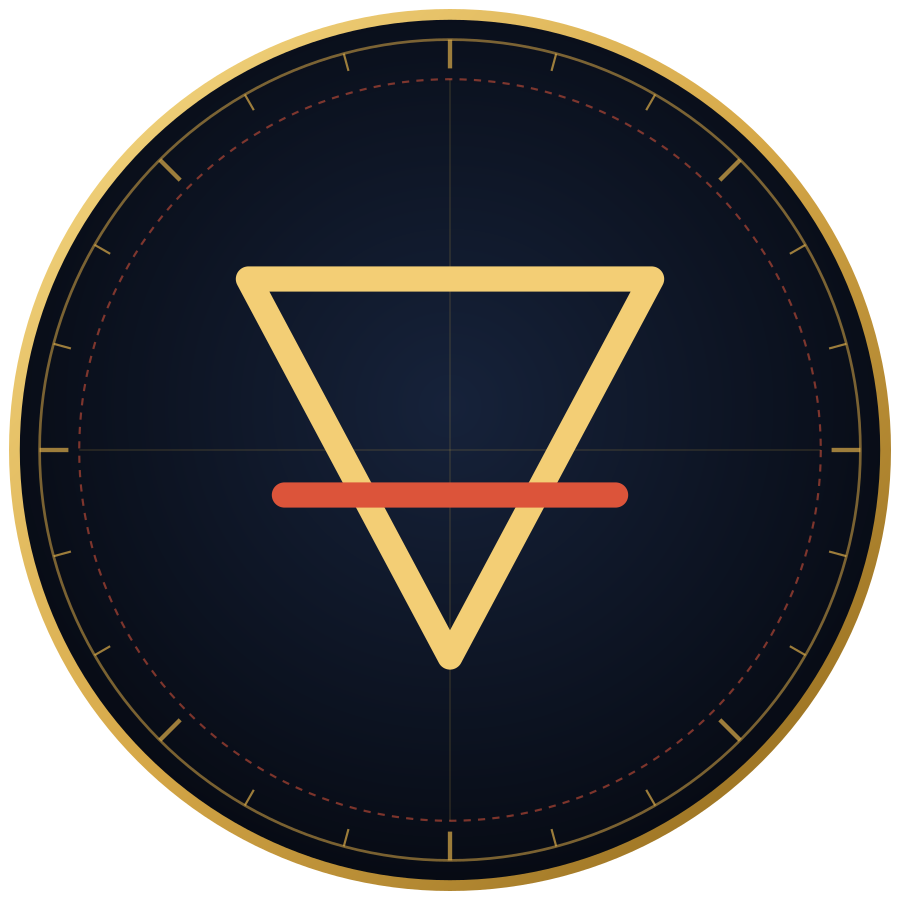
Air (Aer), Latin Aer Spiritus, is the hot, moist classical element and the volatile medium of chymical ascent. Its glyph, U+1F701 (🜁), is a downward triangle barred across the upper third. In the opus it names the path of Sublimatio: what rises, travels, and concretes apart from the gross earth.
I.Glyph Geometry, Unicode & Scribal Variants
The air glyph U+1F701 (🜁) is an inverted triangle, apex down, crossed by one horizontal bar in the upper third. Two oblique strokes meet at the lower vertex; a level stroke closes the base, enclosing a downward triangle. Scribes raise or lower the bar and sharpen or blunt the apex; fifteenth-century Latin hands keep it high and thin, while later process notes thicken it. Gessmann’s 1899 plates place Aer Spiritus among spiritus signs and record the plain barred triangle beside copies retaining a faint medial tick from a worn model. Newton’s transcripts use the same inverted, barred triangle for aer, opposed to the upright triangle of fire by orientation alone. Aqua is the unbarred downward triangle; terra crosses the lower half; aer keeps one high bar and straight sides, never a circle or Venus loop.
II.Laboratory Chymistry & Material Properties
In the workshop, aer was not a bottled gas but the medium of the open furnace. Bellows, tuyères, and wind-furnaces drove a current across charcoal so that calcination and cupellation could proceed; assayers knew that a dead, enclosed fire left metals uncalcined and that a lively blast whitened litharge and parted noble metal from lead. Sublimation trains—aludel stacked on cucurbit, or a glass helm with recipient—carried volatile bodies upward on heated air and dropped them as flowers on cooler walls: sal ammoniac, sulfur, and orpiment were handled this way, the rising fraction called a spiritus. Mineral sources of such aerial salts included volcanic sal ammoniac and the soot of animal distillation, not a mine of nitrogen. Flame tests and, later, limewater parted fresh air from foul or fixed air, the breathable share now called dioxygen beside inert dinitrogen.
III.Hermetic Correspondence & Planetary Doctrine
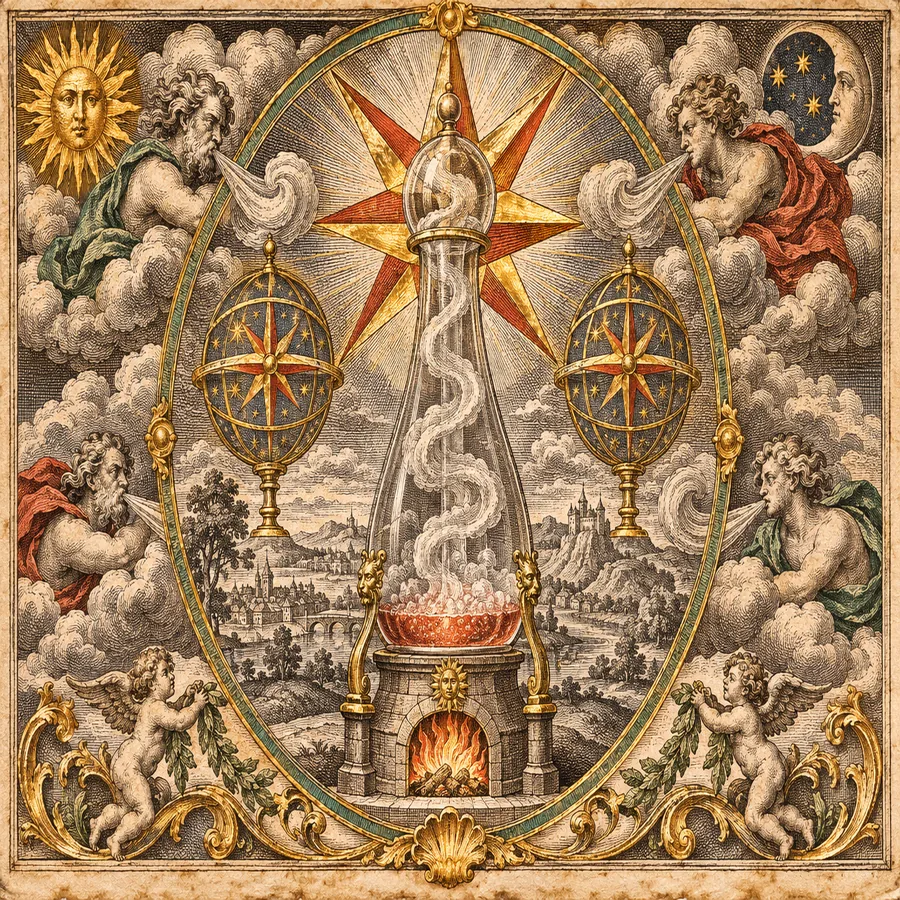
Aristotle placed aer between fire and water: hot and moist, source of breath, wind, and vapor that rises without becoming flame. It stands opposite cold, dry earth; its polarity is levity against weight and openness against occlusion. Jupiter, temperate and expansive, rules the airy triplicity in astrological physic; Mercury governs the laboratory spirit that rises, mediates, and will not stay fixed. Paracelsus kept the four elements but set the tria prima above them, so aer is both an external element and a vehicle of mercury when a body yields spirit. The barred downward triangle borrows water’s cup and marks moisture already turning volatile, neither plain aqua nor upright fire. Emblems show bellows, birds, and a figure pouring breath: the medium that carries vapors between heaven and the glass.
IV.Historical Treatises, Papyri & Emblem Books
Greek theory enters the workshop through Aristotle and through Greco-Egyptian practice linked to Zosimos, where sublimation already lifts volatiles on heated air. Arabic treatises, especially the Jabirian corpus transmitted in Latin as Geber, describe flying spirits and the alembics and aludels that catch them. The Summa perfectionis and related Latin handbooks keep aer as the hot-moist corner of the elemental square. Paracelsus and his editors add a language of aerial niter and archaei that seventeenth-century chymists repeated even when they doubted the physics. Maier’s Atalanta fugiens (1618) joins emblem, epigram, and fugue so that air is shown as an operation, not only a name. Later symbol lists, of the kind Gessmann compiled, fix the barred inverted triangle as Aer or Spiritus: what the vessel admits or shuts out when matter is made to rise.
V.Role in the Magnum Opus & Laboratory Operations
Sublimatio is the opus operation proper to aer. A body is heated so that its volatile part leaves the caput mortuum, travels through the neck or aludel, and concretes on a colder surface as flores. Repeated rise and fall—volatilize, then cool—continues until little gross earth remains and the spirit stands free of slag. Furnace draft brings heat; the hollow of the glass is the road the spirit travels. Sublimation commonly follows calcination and precedes fixation or imbibition, which returns the volatile to an earth that can bear fire. Jupiter’s expanse and Mercury’s mobility are emblems of that ascent, not replacements for lute and lamp. A poor joint spills the spirit into the room; a sound one lets aer make an occult quality visible as a deposit.
VI.Transition to Modern Chemistry & Cultural Legacy
Eighteenth-century pneumatic chemistry dismantled aer as a simple element. Black’s fixed air, Cavendish’s inflammable air, and the oxygen of Scheele, Priestley, and Lavoisier showed common air as a mixture, chiefly azote (nitrogen) and oxygen. The old split between air that feeds calcination and air that kills flame became a composition. Berzelius and his peers replaced pictorial signs with letter formulae, so N and O, not a barred triangle, named the gases. Unicode 6.0 (2010) placed Alchemical Symbols at U+1F700–U+1F77F and set U+1F701 as AIR, the inverted triangle with one bar. Principe reads that survival as a key to furnace practice, not as proof that earlier authors already possessed the chemistry of N2 and O2.
FAQ — Air (Aer)
What does the Air (Aer) symbol mean in chymical texts?
It marks the hot, moist classical element and the volatile spirit that can be driven upward. In process notes it signals sublimation, ventilation, or an aerial fraction rather than a weighed mineral body. Orientation separates it from fire: air points down and is barred; fire points up.
How is Unicode U+1F701 drawn, and how does it differ from water?
U+1F701 is an inverted triangle with a single horizontal bar across the upper third. Water is the same downward triangle without that bar; earth adds a lower crossing and is often read as bisected. Straight sides and an open triangular field keep aer distinct from Venus.
Did laboratory air match the symbolic element Aer?
Operators treated air as a working medium: bellows, open calcination, and closed vessels that either admitted or excluded a draft. Symbolic Aer named the hot-moist pole and the path of sublimed spirit. Modern N2/O2 analysis explains combustion and inert bulk, but it does not reproduce the chymical category.
References
- Wikipedia: Air (classical element) — Wikipedia Contributors (Wikimedia Foundation, 2026) · 2026-11-12The Wikipedia reference records Air, or Wind, as one of the four classical elements with water, earth, and fire in Greek philosophy and Western alchemy.
- Die Geheimsymbole der Chemie und Medicin des Mittelalters — Gustav Wilhelm Gessmann (Verlag des Verfassers (Graz / München), 1899)Gessmann’s Die Geheimsymbole der Chemie und Medicin des Mittelalters (1899) classes Aer Spiritus among medieval spiritus signs and reproduces the barred inverted triangle.
- The Secrets of Alchemy & Unicode Standard Block U+1F700 (Alchemical Symbols) — Lawrence M. Principe / Unicode Consortium (University of Chicago Press / ISO/IEC 10646, 2013) · 2026-11-12Unicode places AIR at U+1F701 in the U+1F700 Alchemical Symbols block, while Principe’s Secrets of Alchemy reads such signs as indices of historical furnace practice rather than covert modern chemistry.
Related
Updated: · Editor: Tabula Chymica Editorial Archive