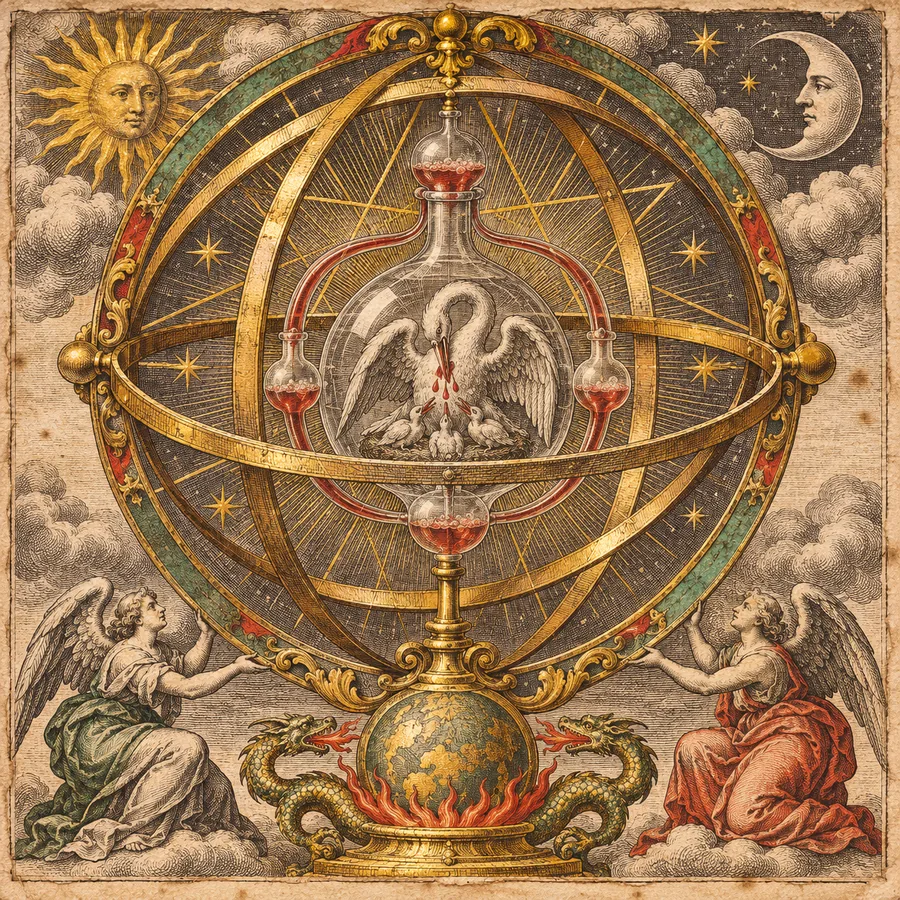
Quintessence (Aether)
Quintessence (quinta essentia) is Aristotle's celestial fifth element and the chymists' fully rectified spirit of wine.
🜀 · Chem: Spiritus Vini / Fifth Element- Chymical Order
- I · Four Elements & Quintessence
- Latin Term
- Quinta Essentia
- Unicode
- U+1F700
- Modern Chemistry
- Spiritus Vini / Fifth Element
- Planetary Sphere
- Caelum Stellatum
- Magnum Opus Stage
- Multiplicatio
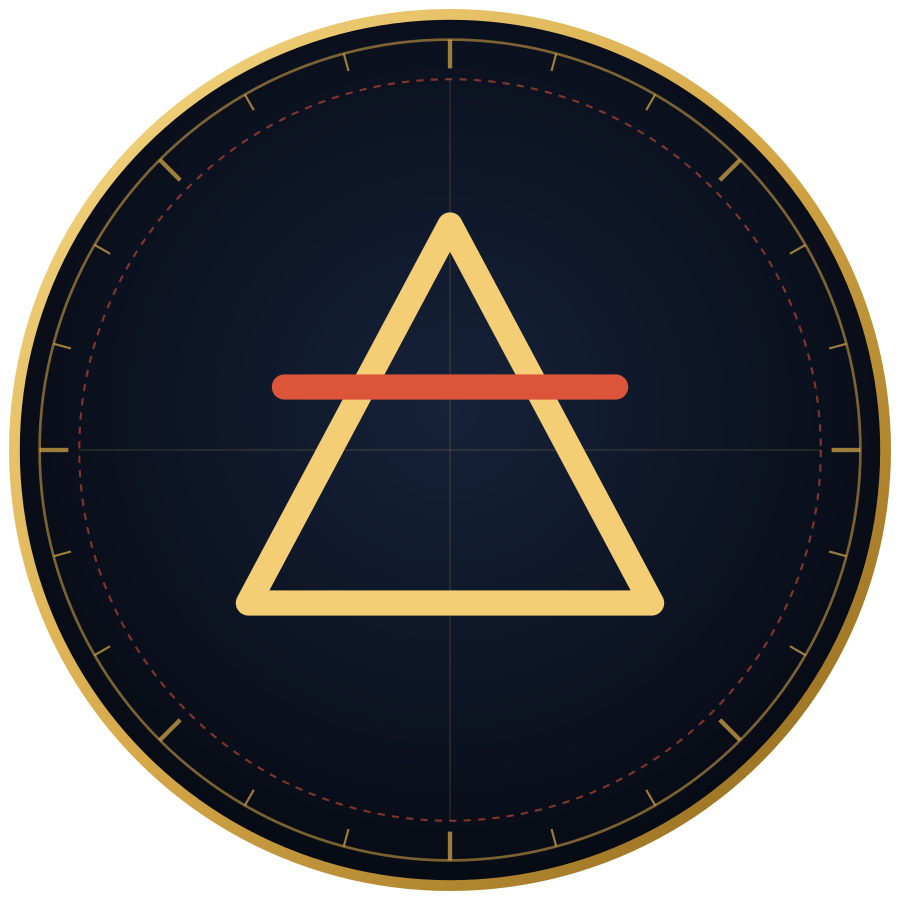
Quintessence (Latin quinta essentia; sign 🜀, U+1F700) denotes Aristotle's unchanging celestial aether and the chymists' most rectified volatile. Its circle is completeness; the horizontal stroke sets the heavenly sphere apart from fire, air, water, and earth. In the workshop it was spiritus vini, repeatedly distilled, the subtle menstruum of the opus.
I.Glyph Geometry, Unicode & Scribal Variants
The glyph 🜀 (U+1F700) is a circle bisected by a horizontal diameter that meets the rim and stops. Scribes drew the ring, then the bar. Rays, a vertical arm, and a central dot are foreign to it. Newton's papers, read by Principe and Newman, seldom show this monogram; quinta essentia is spelled or contracted, and a starred circle more often signals a celestial or solar sense. Gessmann (1899) groups quinta essentia with circular essence-signs: empty ring, barred ring, and ring-and-cross. Earth in astronomy is a circle with an upright cross. Salt is often a barred circle, the bar sometimes prolonged. Sol is a circled point. A bare circle may mean only gold or perfection. Unicode fixes the barred circle as quintessence; older hands were not so consistent.
II.Laboratory Chymistry & Material Properties
In the workshop quinta essentia was a distillate, not a piece of the heavens. Spiritus vini was drawn from wine in cucurbit and alembic; phlegm was rejected and the ardent portion cohobated over the balneum until it burned clean and left no residue. Paracelsian operators likewise circulated plants, minerals, and metals in a pelican, then separated a subtle liquor from the caput mortuum. Assayers noted that this wine-spirit mixed with water in any proportion, dissolved resins and some salts, and did not attack metals unless a corrosive was added. Niter, vitriol, and tartar gave sharp spirits by strong heat; those were kept apart from the sweet, inflammable quintessence. Notes record ready flame, coldness as it evaporated, and a power to preserve flesh and herbs. Celestial aether had become a volatile one could weigh and burn.
III.Hermetic Correspondence & Planetary Doctrine
Quintessence belongs to the caelum stellatum, the starry heaven beyond the seven planetary spheres. For Aristotle it was a fifth body, neither hot nor cold nor wet nor dry, circling without generation or corruption. Medieval Latin readers received that doctrine beside Plato's Timaeus and the Arabic tradition of a superior substance. Paracelsus relocated the idea inside mixed bodies: every thing held a quinta essentia, separable by art, in which its virtue resided. Above, aether is permanence against the strife of the four elements; below, the extracted spirit penetrates, nearer fire and air than earth, yet prized for a balance they lack. It is lunar only as a liquor and solar in the clarity of its flame. The starry heaven remains its emblem: not one planet, but the sphere that contains them all.
IV.Historical Treatises, Papyri & Emblem Books
The notion begins in Aristotle's De caelo, where aither fills the region above the Moon. Greco-Egyptian papyri and texts under Zosimos' name treat distilled waters rather than the fifth body; later readers still tied those arts to quinta essentia. Arabic philosophy carried the celestial element into Latin. In the fourteenth century John of Rupescissa's De consideratione quintae essentiae taught a medicine drawn from wine and gold that guided Latin practice for generations. Paracelsus made quintessence a standing name for arcana taken from herbs, minerals, and metals. Michael Maier's Atalanta fugiens (1618) places celestial and volatile images beside epigrams of separation, without furnace quantities. Later collections such as the Basilica philosophica repeat an essence set above the four elements. The word thus passes from cosmology to a product of the still.
V.Role in the Magnum Opus & Laboratory Operations
Within the Magnum Opus, quintessence belongs to multiplicatio, when a perfected tincture is increased rather than first composed. After the body has been calcined, dissolved, conjoined, and fixed, the operator feeds it a measured charge of rectified spiritus vini. The liquor opens the mass, carries virtue through it, and is drawn off and returned until that virtue is said to have grown. Excess spirit drowns the work; a poorly rectified liquor brings back phlegm. Multiplication is a controlled feeding: the fifth essence is the ferment's vehicle, not the stone. When the augmented matter again bears the fire, the same spirit may medicate or project in a larger dose. The vessels remain the cucurbit, alembic, and pelican, at the heat of the bath or ashes.
VI.Transition to Modern Chemistry & Cultural Legacy
Lavoisier's reform, carried into Berzelius's letter-symbols, retired essence-names. Quinta essentia and spiritus vini gave way to ethanol and to formulas a barred circle cannot express. Distillation remained: rectified spirit of wine is ethanol enriched by fractionation, inflammable, miscible with water, and no proof of a celestial body. Physics later borrowed 'aether' for a light-bearing medium; Michelson-Morley found no such drift, and the medium was dropped. Principe and other historians keep quintessence as a period name for Aristotelian heaven and laboratory spirits, not as a gap in the periodic table. Unicode U+1F700, in the Alchemical Symbols block, assigns the barred circle to plain text. The code point saves a scribal habit; it restores neither the cosmos nor the furnace.
FAQ — Quintessence (Aether)
What does the Quintessence (Aether) symbol mean in chymical texts?
The barred circle marks the fifth essence: Aristotelian aether above the Moon and, in chymical usage, a fully rectified spirit, commonly spirit of wine. It is not a sign for one metal, nor the astronomical symbol of Earth.
How is the Unicode glyph U+1F700 drawn, and which signs resemble it?
U+1F700 is a circle crossed by one horizontal diameter that ends at the circumference. It must be kept distinct from the circled dot of Sol and from the circle surmounted by an upright cross used for Earth.
Was quintessence a laboratory product or only a cosmic symbol?
Both senses were active. Cosmology named an incorruptible element beyond the Moon, while the still yielded an inflammable distillate called quinta essentia or spiritus vini. One name covered the heavenly body and the measurable liquor.
References
- Wikipedia: Aether (classical element) — Wikipedia Contributors (Wikimedia Foundation, 2026) · 2026-11-12The Wikipedia account presents aether as the fifth element beyond the terrestrial sphere and records the luminiferous-aether hypothesis left without support by the Michelson–Morley experiment.
- Die Geheimsymbole der Chemie und Medicin des Mittelalters — Gustav Wilhelm Gessmann (Verlag des Verfassers (Graz / München), 1899)Gessmann’s Die Geheimsymbole der Chemie und Medicin des Mittelalters (1899) classes quinta essentia among circular essence-signs and separates empty, barred, and crossed forms.
- The Secrets of Alchemy & Unicode Standard Block U+1F700 (Alchemical Symbols) — Lawrence M. Principe / Unicode Consortium (University of Chicago Press / ISO/IEC 10646, 2013) · 2026-11-12Unicode U+1F700 encodes the barred circle in the Alchemical Symbols block, while Principe’s history of alchemy sets quintessence between Aristotelian heaven and the spirits of the still.
Related




Updated: · Editor: Tabula Chymica Editorial Archive