Black Sulfur (Sulphur Nigrum)
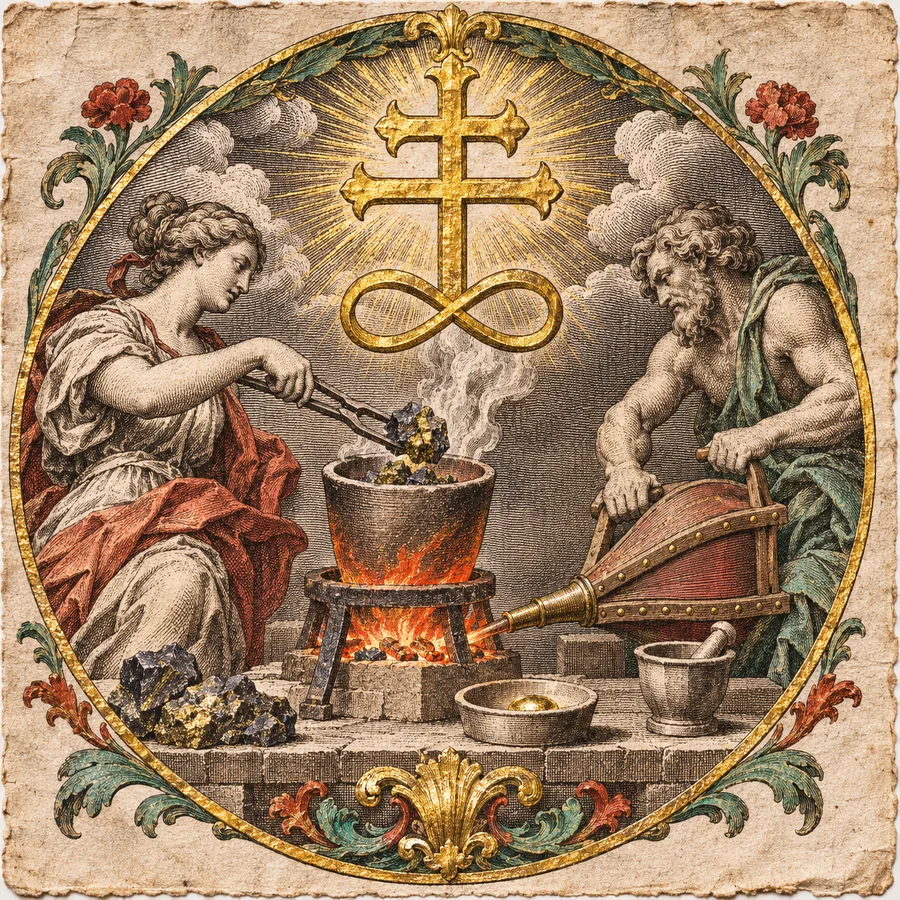
Black Sulfur (Sulphur Nigrum) is the Saturnine black sulfur of chymistry, glyph 🜏, proper to the Nigredo.
🜏 · Chem: S8 / Metal Sulfide Residue- Chymical Order
- II · Paracelsian Tria Prima
- Latin Term
- Sulphur Nigrum / Caput Corvi
- Unicode
- U+1F70F
- Modern Chemistry
- S8 / Metal Sulfide Residue
- Planetary Sphere
- Saturnus
- Magnum Opus Stage
- Nigredo
Sulphur Nigrum names a Saturnine sulfur set apart, in Renaissance chymical notation, from common brimstone and from the philosophers' sulfur. The glyph 🜏 (U+1F70F) joins a low cross to a hooded triangular mass, a geometry read as fixation, corruption, and the raven's head. In practice the name pointed to dark sulfide residues and to the opening blackness of the Magnum Opus, not to a modern element.
I.Glyph Geometry, Unicode & Scribal Variants
The glyph 🜏 uses a low saltire under a triangular hood. Stem and crossbar form the cross; two diagonals close the hood, often on a short baseline. A filled or hatched hood means blackness, not another substance. Scribes change arm angle, stem length, and peak. Newton's papers, denser in signs than Lüdy-Tenger's 3,695, add ticks and planetary marks to sulfur crosses; black sulfur is named in a caption or set beside Saturn, not locked to one monogram. Gessmann (1899) files Sulphur nigrum with caput corvi, apart from sulfur vivum and red or white sulfur. Plain brimstone is the cross without a hood. Antimony and vitriol saltires share the cross but lack that hood and the nigrum or corvus gloss. Emblem cuts shrink the hood; notes keep a freer cross.
II.Laboratory Chymistry & Material Properties
Workshop sulfur nigrum was a dark product, not bottled pure brimstone. Native sulfur, or sulfur from roasted pyrite, melts, burns blue, and gives a sharp fume. Fused with iron, copper, lead, or antimony, or left as matte when a sulfide ore was dead-roasted, it became a black or liver-colored mass and scoria. Assayers weighed regulus against caput mortuum: one portion stayed in the crucible or on the cupel, another fled as fume. Liver of sulfur, brimstone melted with potash or quicklime, is brown-black; water extracts a yellow-brown liquor, and acids free a fetid spirit. Galena, stibnite, and pyrite are mineral cousins, dark and brittle, calcining to a pale earth. Vessels were crucible, muffle, alembic, and balance. The name marks color and fixity. A modern tag, S8 or metal-sulfide residue, only half translates it.
III.Hermetic Correspondence & Planetary Doctrine
Saturn governs this sulfur. Cold, dry, heavy, and slow, the planet supplies the Aristotelian qualities assigned to black, earthy, melancholic matter, as against solar sulfur's heat or lunar humidity. In the tria prima of Paracelsus, sulfur is the principle of combustibility and oiliness in every body; nigrum specifies the unpurified, corporeal, Saturnine face of that principle, not the sophic sulfur that later whitens and reddens. The polarity is deliberate. White and red sulfurs stand for separated, noble tinctures; black sulfur stands for the body still mixed with its dregs, kin to lead and to caput mortuum. Caput corvi, the raven's head, names the same polarity in emblem: corruption before washing, death of the old metal before any resurrection. The sign marks descent, fixation, and a patience proper to Saturn rather than a poison prized for itself.
IV.Historical Treatises, Papyri & Emblem Books
Greco-Egyptian technical papyri and the works associated with Zosimos already treat sulfur (theion) as a coloring and cementing agent and treat melanosis, blackening, as the first movement of transmutation. They do not draw the later hooded cross. Arabic and Latin medieval texts keep sulfur as elixir and mineral spirit; receipts separate sulfur vivum from brimstone and, later, name black or earthy sulfurs after calcination. Paracelsus and his editors fix sulfur inside the tria prima, while practical iatrochemical books describe liver of sulfur and dark antimonial or martial sulfides without always using the nigrum glyph. Emblem books make the iconographic link. Michael Maier's Atalanta Fugiens (1618) stages the black crow and the grave of the king as public images of nigredo; symbol lexica then pin Sulphur nigrum and caput corvi to that same moment.
V.Role in the Magnum Opus & Laboratory Operations
In the Magnum Opus, black sulfur belongs to nigredo, the putrefaction that opens the work. Operators calcine, cement, or circulate a metal with sulfur until the mass blackens, loses metallic look, and is called caput corvi or caput mortuum. The practical aim is not to linger in stench. Blackening shows that the old texture has been opened so a volatile spirit can be fixed or a fixed body made able to receive moisture again. Sequences differ by school: some sublime sulfur, return it to the earth, and repeat; others roast a sulfide, wash the black feces, and recombine feces with a distilled vinegar or a mercurial water. Across those recipes the sign 🜏 tells the reader that the sulfur in play is the dark, Saturnine species, not the white sulfur of albedo or the red sulfur of rubedo. Color is the clock.
VI.Transition to Modern Chemistry & Cultural Legacy
Eighteenth-century reform made the glyph obsolete as a working notation. Lavoisier's chemistry and the 1787 nomenclature replaced chymical sulfur-titles with a substance defined by weight and by its acids. Berzelius then set the alphabetic symbol S, later understood as the element of atomic number 16, whose common molecule is the eight-membered ring S8. Metal sulfides such as pyrite, galena, stibnite, and alkali polysulfides remain real, now FeS2, PbS, Sb2S3, or salts, not Saturnine arcana. Newman and Principe read the older term in laboratory practice and natural philosophy, not as a code for modern formulas. Unicode kept the picture. U+1F70F, ALCHEMICAL SYMBOL FOR BLACK SULPHUR, entered Unicode 6.0 (2010) in the block from U+1F700. It records a habit of the pen and does not equate S8 with caput corvi.
FAQ — Black Sulfur (Sulphur Nigrum)
What does the Black Sulfur (Sulphur Nigrum) symbol mean in chymical notation?
It marks the dark, Saturnine species of sulfur tied to fixation and to caput corvi, the raven's head of nigredo. Lexica separate it from ordinary brimstone and from the white or red sulfurs of later stages. The sense is chymical and emblematic, not a modern molecular formula.
How is the Unicode glyph U+1F70F for black sulfur drawn?
U+1F70F is named ALCHEMICAL SYMBOL FOR BLACK SULPHUR. The usual figure is a sulfur cross of stem and bar, crowned by a triangular hood. Scribes vary the peak, the stem, and any hatching; a caption such as nigrum or corvus settles doubtful lookalikes.
Was Sulphur Nigrum a real laboratory product or only a symbol?
Both. Assayers and chymists handled dark sulfide mattes, scoriae, and liver of sulfur with familiar color, weight, and fumes. The Saturnine name and the glyph placed those products inside nigredo. Modern S8 and named metal sulfides translate only part of that workshop category.
References
- Wikipedia: Alchemical symbol — Wikipedia Contributors (Wikimedia Foundation, 2026) · 2026-11-12The Wikipedia reference documents the wide variation of alchemical signs for substances, apparatus, and processes into the eighteenth century and the incompleteness of inventories such as Lüdy-Tenger's.
- Die Geheimsymbole der Chemie und Medicin des Mittelalters — Gustav Wilhelm Gessmann (Verlag des Verfassers (Graz / München), 1899)Gessmann's Die Geheimsymbole der Chemie und Medicin des Mittelalters (1899) classes Sulphur nigrum among secret chemical and medical signs and aligns it with caput corvi rather than with common brimstone.
- The Secrets of Alchemy & Unicode Standard Block U+1F700 (Alchemical Symbols) — Lawrence M. Principe / Unicode Consortium (University of Chicago Press / ISO/IEC 10646, 2013) · 2026-11-12Unicode standardizes BLACK SULPHUR as U+1F70F in the Alchemical Symbols block from U+1F700, while Principe's history of alchemy places such Saturnine names in period laboratory practice and natural philosophy.
Related





Updated: · Editor: Tabula Chymica Editorial Archive