Sulfur (Brimstone)
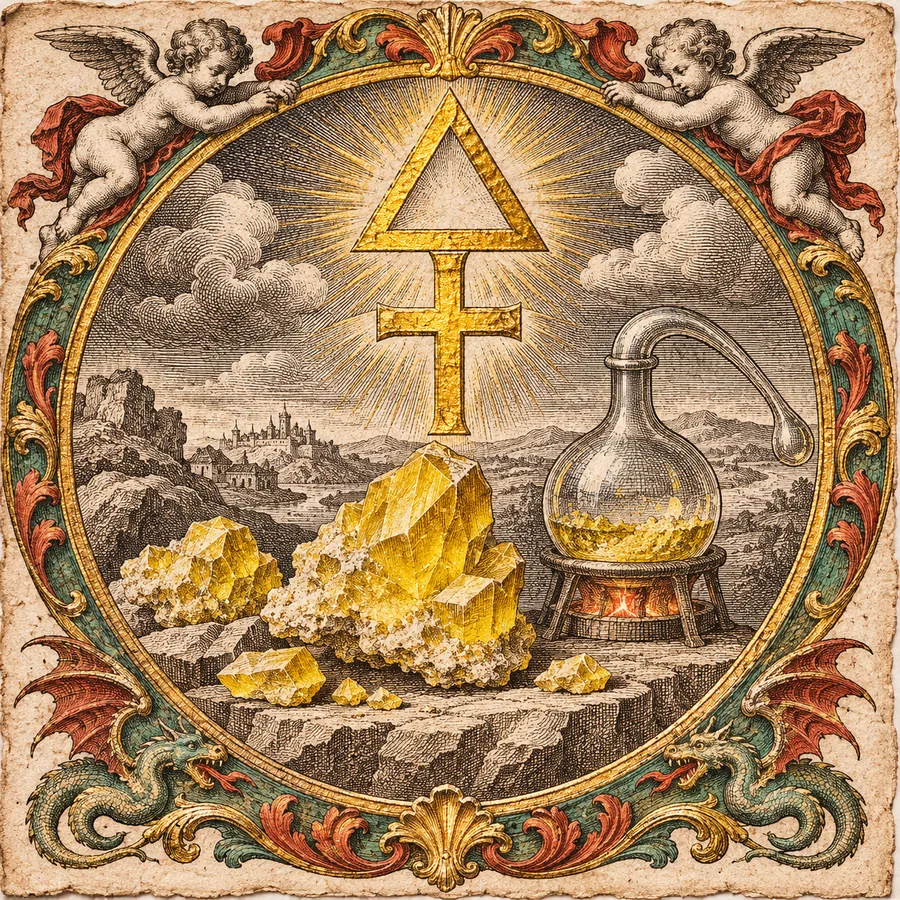
Sulfur, or brimstone (Sulphur Philosophorum), is the solar chymical soul of combustibility, signed by the glyph 🜍 (S8).
🜍 · Chem: S8- Chymical Order
- II · Paracelsian Tria Prima
- Latin Term
- Sulphur Philosophorum
- Unicode
- U+1F70D
- Modern Chemistry
- S8
- Planetary Sphere
- Sol (Anima)
- Magnum Opus Stage
- Citrinitas / Rubedo
Sulfur, called brimstone and in Latin Sulphur Philosophorum, is the bright yellow nonmetal whose stable form is cyclic S8. Renaissance chymists ranked it with Sol as anima, the hot oily soul. The glyph 🜍 (U+1F70D) sets a fire-triangle upon a cross, signifying combustible virtue that yellows and then reddens the metallic body.
I.Glyph Geometry, Unicode & Scribal Variants
The reference glyph 🜍 (U+1F70D) is built from two Aristotelian marks: an upward triangle, the sign of fire, seated on a Greek cross of the four elements. Scribes draw the triangle in three strokes—two slanted sides and a base that may fuse with the crossbar—then a vertical stem and a horizontal arm. In many hands the upper angle is left open, so the figure reads as a forked staff rather than a closed delta. Newton’s laboratory notes and the plates gathered by G. W. Gessmann record both the closed triangle-cross and a cursive form whose right arm curls upward, sometimes mistaken for a corrupted Mercury. The sign must be kept apart from Mars (circle and arrow), from the antimony cross, and from the male sign used for iron.
II.Laboratory Chymistry & Material Properties
In the workshop brimstone was a familiar mineral, not a metaphor alone. Native sulfur was dug at Sicilian and Campanian solfataras, or condensed as flowers of sulfur when pyrites and marcasite were roasted in earthen retorts. The solid is brittle, bright yellow, and odorless until warmed; it melts to a mobile amber liquid, then thickens, and burns with a blue flame whose sharp vapor attacks the lungs and tarnishes silver. Assayers roasted sulfurous ores before cupellation because residual brimstone made metal brittle and spoiled the button. Heated with quicksilver it yields red cinnabar, a union chymists took as soul entering spirit. The modern formula S8 names the crown-shaped ring of eight atoms that accounts for this yellow crystalline body; early operators knew the substance by color, fusibility, and combustibility, not by molecular structure.
III.Hermetic Correspondence & Planetary Doctrine
Under the planetary rubric given to this entry, sulfur belongs to Sol and is the anima, the individual soul of a metal or a mixt. Aristotelian physics classed brimstone as hot and dry, hence fiery, in contrast to the cold moisture of philosophical mercury. Paracelsus and his followers made sulfur one of the tria prima: salt the body, mercury the spirit, sulfur the soul that confers color, odor, and combustibility. The polarity is masculine and active against lunar receptivity, yet the soul is also the volatile that must be fixed. Too much sulfurous virtue burns a metal to dross; too little leaves it pale and unripe. Adepts therefore spoke of an inward, incombustible sulfur—the true solar seed—distinct from common brimstone, which only imitates that secret heat.
IV.Historical Treatises, Papyri & Emblem Books
Greco-Egyptian artisans already handled sulfur as a workshop reagent: the Leiden and Stockholm papyri prescribe it in gilding and dyeing, and Zosimos of Panopolis folds such operations into a spiritual metallurgy. Arabic authors named the mineral kibrīt and debated whether metals were compounded of sulfur and mercury, a doctrine Latinized in the Geberian Summa perfectionis and its commentary tradition. Medieval recipe books list brimstone beside vitriol, sal ammoniac, and orpiment. Paracelsus recast the pair as the tria prima, so that sulfur became a universal soul rather than only a mineral ingredient. Michael Maier’s Atalanta Fugiens (1618) and Mylius’s Basilica philosophica stage sulfur with its lunar consort for readers who also worked at the furnace. Across these texts the word covers common brimstone, sulfurous vapors from pyrites, and the hidden sulfur of the metals.
V.Role in the Magnum Opus & Laboratory Operations
In the color sequence of the Magnum Opus, sulfur governs the passage from citrinitas into rubedo. The yellow stage is not mere pigment: it is the appearance of solar soul in the matter, when a citrine or golden surface signals that the inward sulfur has been awakened. Operators sublimed flowers of sulfur, digested them with philosophical mercury, and sought to fix the volatile yellow so it would no longer flee the fire. Calcination drove off crude, burning sulfur; digestion and coction were said to ripen the remaining soul toward red. In rubedo the fixed sulfur becomes the tinging ferment that colors the metallic body, the anima united with body and spirit. Common brimstone only illustrates the effects; the stone’s sulfur, they insisted, is generated inside the vessel.
VI.Transition to Modern Chemistry & Cultural Legacy
Eighteenth-century chemistry stripped brimstone of its status as a principle. Lavoisier placed sulfur among the simple substances that survive analysis, and the Berzelian symbol S replaced the triangle-cross in laboratory notation. The stable room-temperature form is orthorhombic sulfur, built from crown-shaped S8 rings; it is a bright yellow crystalline solid, atomic number 16, multivalent and nonmetallic. Other allotropes—polymeric chains, monoclinic crystals—explain the thickening of molten sulfur that artisans had long observed. The old glyph did not vanish. Unicode gathered the early-modern signs into the Alchemical Symbols block and assigned SULFUR to U+1F70D, so that 🜍 can be set beside S8 without confusing a chymical soul with an elemental formula.
FAQ — Sulfur (Brimstone)
What does the Sulfur (Brimstone) symbol mean in chymical texts?
The sign 🜍 marks Sulphur Philosophorum, the hot, combustible soul rather than a mere mineral label. In Paracelsian theory it is the anima that gives color, odor, and flammability, set under Sol and opposed to cold, moist mercury. Common brimstone was the visible analogue of that inward sulfur.
How is Unicode U+1F70D drawn, and which signs is it not?
U+1F70D is an upward fire-triangle set on a cross, sometimes left open at the apex or given a curled arm in cursive hands. It is not the Mars sign (circle and arrow), not the plain antimony cross, and not the solar disk. Gessmann’s plates and Newtonian notes show both the closed and the cursive forms.
How did laboratory brimstone differ from symbolic sulfur?
Workshop brimstone was yellow native sulfur or flowers condensed from roasted pyrites, fusible, blue-flamed, and able to make cinnabar with mercury. Symbolic sulfur was the incombustible solar seed said to ripen inside the vessel from citrinitas to rubedo. Operators used the mineral to illustrate effects they refused to identify with the stone itself.
References
- Wikipedia: Sulfur — Wikipedia Contributors (Wikimedia Foundation, 2026) · 2026-11-12The Wikipedia summary documents sulfur as element 16, a multivalent nonmetal whose ordinary form is bright yellow crystalline S8.
- Die Geheimsymbole der Chemie und Medicin des Mittelalters — Gustav Wilhelm Gessmann (Verlag des Verfassers (Graz / München), 1899)Gessmann’s Die Geheimsymbole der Chemie und Medicin des Mittelalters (1899) classes Sulphur Philosophorum among the triangle-cross and cursive sigla distinct from Mars and related metallic marks.
- The Secrets of Alchemy & Unicode Standard Block U+1F700 (Alchemical Symbols) — Lawrence M. Principe / Unicode Consortium (University of Chicago Press / ISO/IEC 10646, 2013) · 2026-11-12Unicode places the sign at U+1F70D in the Alchemical Symbols block, while Lawrence Principe’s history of alchemy separates that chymical soul from the later elemental formula S8.
Related




Updated: · Editor: Tabula Chymica Editorial Archive