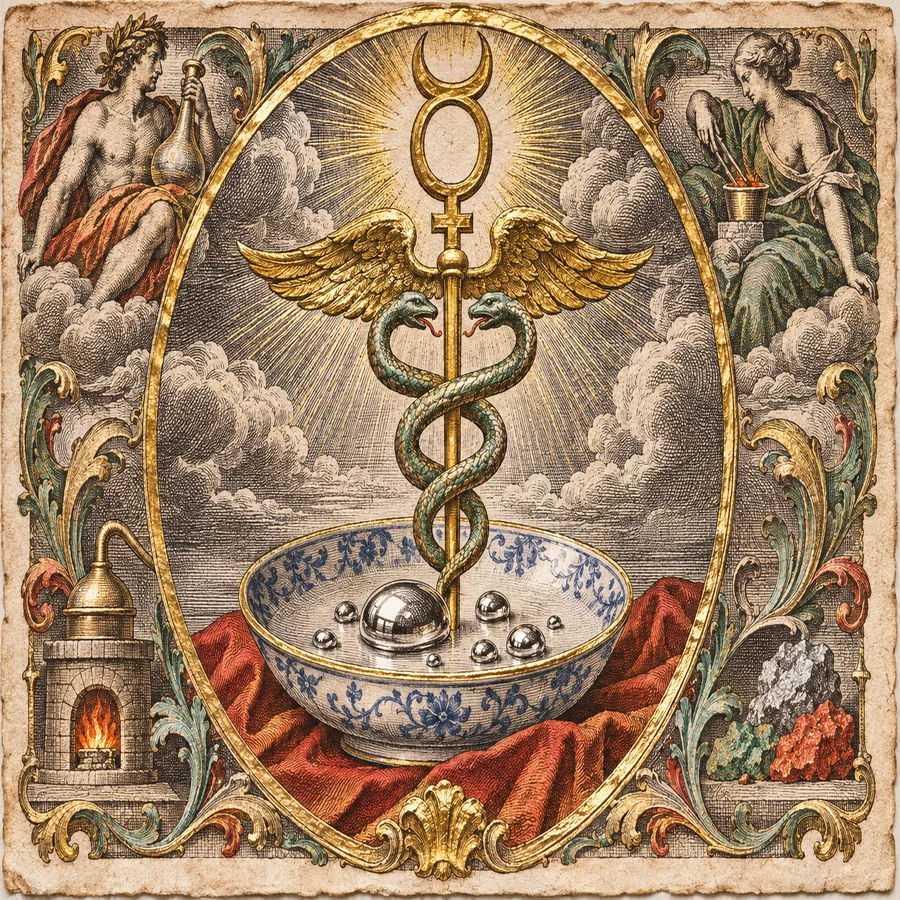
Mercury (Quicksilver)
Mercury, or quicksilver (Argentum vivum, Hg, ☿), is the liquid metal and volatile spirit of chymistry, planet of Mercurius and agent of Albedo.
☿ · Chem: Hg- Chymical Order
- II · Paracelsian Tria Prima
- Latin Term
- Argentum Vivum
- Unicode
- U+263F
- Modern Chemistry
- Hg
- Planetary Sphere
- Mercurius (Spiritus)
- Magnum Opus Stage
- Albedo
Mercury, called quicksilver and in Latin Argentum vivum, is the dense silvery metal that remains liquid under ordinary heat, written Hg and signed ☿ (U+263F). Its glyph stacks lunar crescent, solar circle, and earthly cross. Renaissance chymists treated it at once as a mine product distilled from cinnabar and as Mercurius, the mediating spirit of the Albedo.
I.Glyph Geometry, Unicode & Scribal Variants
The sign ☿ (U+263F) is built in three stacked strokes: a crescent opening upward, a small circle centered beneath its horns, and a Greek cross whose vertical stem drops from the circle. Scribes often drew the crescent as two short arcs rather than one bow, and the cross as a plus with equal arms or as a Latin cross with a longer stem. Isaac Newton's alchemical manuscripts employ a compact ☿ close to the astronomical form, sometimes slightly tilted in rapid notes. G. W. Gessmann's tables of 1899 gather Argentum vivum under several pen-variants—crescent enlarged, circle reduced to a dot, cross detached—yet the tripartite order remains diagnostic. The sign must not be confused with Venus (♀), a circle over a cross without the crescent; with Earth (⊕ or ♁); or with the staff-and-serpents caduceus, a figurative attribute of Hermes.
II.Laboratory Chymistry & Material Properties
In the laboratory, quicksilver was won chiefly from cinnabar (mercuric sulphide) by roasting with air or by heating with iron or lime in retorts and earthen sublimatories, the metal collecting as a bright running liquid. Mines at Almadén and Idrija supplied Europe. Assayers knew its singular habits: it does not wet glass, it amalgamates gold and silver and thereby "kills" their malleability, and it flies in a moderate fire yet is recovered unchanged by condensation. It will not endure cupellation as lead does; instead it served to extract noble metals from ores and sweepings by amalgamation, the amalgam then being strained through leather and the mercury driven off by heat. Specific weight and a mirror surface were stock observations long before thermometry set its freeze near -39 °C and its boil near 357 °C. Iron and glass resist it; tin, lead, and copper are eaten into amalgams.
III.Hermetic Correspondence & Planetary Doctrine
Under the planetary name Mercurius, quicksilver occupied the sphere of Spiritus, the mobile mean between Sol and Luna. Aristotelian commentators often classed the metal as cold and moist, watery in temperament yet metallic in body; Paracelsus recast that inheritance as one of the tria prima, the volatile mercury set against sulphurous soul and saline body. The polarity is deliberate: common quicksilver is fugitive, penetrating, and ambivalent in sex, now bride and now bridegroom, while the philosophical mercury sought by adepts was a prepared spirit, not the crude metal from the mine. As spirit it joins what sulphur divides and what salt fixes. Emblems therefore arm Mercurius with the caduceus, a mark of mediation. That duplex character lets chymical Mercurius name both the solvent and the matter dissolved.
IV.Historical Treatises, Papyri & Emblem Books
Greco-Egyptian technical papyri already record recipes for making and using quicksilver, and Zosimos of Panopolis folds the metal into a spiritual metallurgy of distillation and tincture. Arabic authors transmitted both the practical art and the doctrine of a mercury-sulphur composition of metals; the Latin Summa perfectionis attributed to Geber set Argentum vivum at the center of assaying and of the theory of metallic generation. Medieval compendia repeat that teaching under Albertine and Lullian names. Paracelsus, in the sixteenth century, made mercury one of three principles governing not only ores but medicine. Michael Maier's Atalanta fugiens (1618) stages Mercurius in emblems and fugues as the fugitive guide of the work. Newton's indexes cross-list ☿ with quicksilver and philosophical mercury. Gessmann's corpus of 1899 then fixed those scribal habits in print.
V.Role in the Magnum Opus & Laboratory Operations
In the sequence of the Magnum Opus, quicksilver belongs especially to the Albedo, the whitening that follows the black putrefaction. Crude metal may open the work—as a bath that amalgamates the body, as a volatile spirit driven upward and cohobated, or as the "mercury of the philosophers" prepared by long circulation—but adepts insisted that mine quicksilver alone does not whiten the stone. The white stage is marked by ablution, by the appearance of a lunar or silvery earth, and by a relative fixation in which the fugitive spirit is partly bound. Texts speak of washing the black body until it shines, of a white sulphur conjoined with mercury, and of a tincture that makes imperfect metal pale and brilliant before any solar reddening. Thus ☿ names both a bench reagent and the principle purified in the Albedo.
VI.Transition to Modern Chemistry & Cultural Legacy
Eighteenth-century reform kept the substance and changed its name's logic. Lavoisier ranked mercury among the simple metallic substances in the Traité élémentaire de chimie (1789), no longer a principle but a ponderable element. Berzelius's alphabetic notation then fixed Hg, from Latin hydrargyrum (Greek hydrargyros, "water-silver"), the symbol still used for atomic number 80. Modern description confirms the old observations in quantitative form: a d-block metal, liquid at standard temperature and pressure, with the lowest melting and boiling points of any metal and a uniquely narrow liquid range. The sign was not erased by that reform. Unicode encodes it as U+263F MERCURY; the Alchemical Symbols block, added in Unicode 6.0 (2010) and beginning at U+1F700, preserves the wider manuscript repertoire around that stable character.
FAQ — Mercury (Quicksilver)
What does the Mercury (quicksilver) symbol ☿ mean in chymistry?
The sign ☿ marks both the liquid metal quicksilver and the planetary spirit Mercurius. It joins a lunar crescent, a solar circle, and an earthly cross, expressing mediation between Sun and Moon. In the Magnum Opus it is tied especially to the whitening, or Albedo.
How is Unicode U+263F drawn, and how does it differ from Venus?
U+263F is drawn as an upward crescent over a circle, with a cross descending from that circle. Venus (♀) is only a circle set above a cross and lacks the crescent. Scribal copies may shrink the circle or lengthen the stem, but the three-part stack remains.
How did laboratory quicksilver differ from philosophical mercury?
Laboratory quicksilver was the distilled metal of cinnabar, used to amalgamate gold and silver and recovered by heating. Philosophical mercury was a prepared spirit in texts of the work, not identical with the crude mine product. Practitioners kept the two senses distinct even when both were signed ☿.
References
- Wikipedia: Mercury (element) — Wikipedia Contributors (Wikimedia Foundation, 2026) · 2026-11-12The Wikipedia summary records mercury (Hg, atomic number 80) as quicksilver, the only metal liquid at standard temperature and pressure, with the lowest freezing and boiling points among metals.
- Die Geheimsymbole der Chemie und Medicin des Mittelalters — Gustav Wilhelm Gessmann (Verlag des Verfassers (Graz / München), 1899)Gessmann's Die Geheimsymbole der Chemie und Medicin des Mittelalters (1899) classifies Argentum vivum among metallic signs and records pen-variants of the crescent-circle-cross character.
- The Secrets of Alchemy & Unicode Standard Block U+1F700 (Alchemical Symbols) — Lawrence M. Principe / Unicode Consortium (University of Chicago Press / ISO/IEC 10646, 2013) · 2026-11-12Unicode places the planetary sign at U+263F and gathers early-modern chymical characters in the block from U+1F700, while Lawrence Principe's Secrets of Alchemy separates common quicksilver from the philosophical mercury of the adepts.
Related




Updated: · Editor: Tabula Chymica Editorial Archive