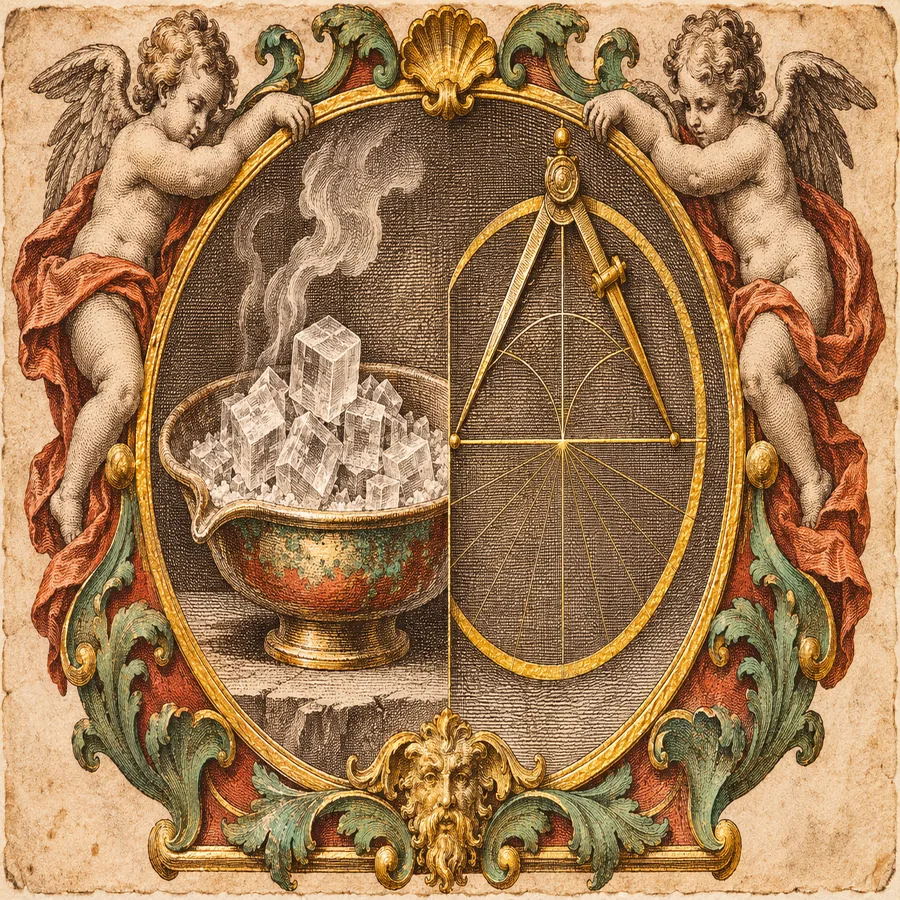
Salt (Sal)
Paracelsian Sal Principium: the fixed bodily principle, glyph 🜔, answering to terra and, in the jar, to common salt.
🜔 · Chem: NaCl / Sal Fixum- Chymical Order
- II · Paracelsian Tria Prima
- Latin Term
- Sal Principium
- Unicode
- U+1F714
- Modern Chemistry
- NaCl / Sal Fixum
- Planetary Sphere
- Terra / Corpus
- Magnum Opus Stage
- Albedo / Coagulatio
In Renaissance chymistry Sal, or Sal Principium, is the third of the Paracelsian tria prima: the bodily, non-volatile principle left when fire resolves a mixed body. Its glyph 🜔 (U+1F714) is a circle bisected by one horizontal diameter, read as corpus and terra—the fixed salt that confers mass, whiteness, and permanence.
I.Glyph Geometry, Unicode & Scribal Variants
The glyph 🜔 comprises a circle and one horizontal diameter that touches the circumference at both ends. It lacks the central dot of Sol and the vertical arm of the earthly cross, so the figure reads as level extension rather than radiance or elevation. Newton often drew the circle slightly oval and the bar freehand, sometimes stopping short of the rim, and he labeled neighboring signs for sal ammoniac and saltpetre with added dots or a second stroke. Gessmann's 1899 plates keep the plain circle-and-bar for Sal Principium and park doubled or dotted forms under specific salts. Theta, the circled minus, and the Earth sign are frequent lookalikes; only an undotted full horizontal diameter, without a vertical, is ordinary chymical salt.
II.Laboratory Chymistry & Material Properties
In the laboratory Sal Fixum is common salt: sal marinum from coastal pans or sal gemmae from mines. Its crystals are cubic, white or colorless, sharply saline, and freely soluble in water. Heated in a crucible the grains decrepitate as trapped moisture bursts them, then melt to a clear liquor that neither flames nor sublimes as sal ammoniac does. Assayers therefore classed it among fixed salts, useful as a mild flux and as a bath in which other bodies were dissolved, crystallized, and weighed. It is no metal and gives no regulus. Spirit of salt, expelled by oil of vitriol in a glass retort, is a volatile acid and is not the fixed residue. Taste, cubic grain, solubility, and refusal to fly in a naked fire were the bench tests that parted sal commune from niter, vitriol, and alkali.
III.Hermetic Correspondence & Planetary Doctrine
Within the tria prima, Sal answers to Terra and to Corpus: it is the body that sulphur, as soul, and mercury, as spirit, inform. Aristotelian matter theory had offered four elements and no separate salt; Paracelsus, writing as physician and lay theologian, treated salt as what remains when a body is burned, the balsamic solidity that resists further resolution. The horizontal bar of the glyph figures that refusal to rise. Polarity is sharp. Volatile salts and spirits flee the fire and belong to the mercurial pole; fixed salt stays, whitens, and crystallizes, and so belongs to the corporeal pole. Too much salt yields a dead, heavy earth; too little leaves the work without cohesion. Chymists therefore spoke of salt as the medium that binds opposites without itself becoming either flame or fume.
IV.Historical Treatises, Papyri & Emblem Books
Greco-Egyptian workshop notes and the writings associated with Zosimos already use common salt in washings and cementations, yet they do not isolate Sal as a universal principle. Arabic mineralogy knows milh as a class of saline minerals; Latin scholastic texts inherit sal commune, sal gemmae, and sal nitrum as distinct substances. The doctrinal shift is Paracelsian. In the early sixteenth century Theophrastus von Hohenheim set salt beside sulphur and mercury as one of three principles of every body, a claim repeated through the Opus Paramirum. Oswald Croll's Basilica Chymica (1609) organized that doctrine for pharmaceutical practice. Michael Maier's Atalanta Fugiens (1618) then set salt among emblems of fixation and whitening, while recipe manuscripts kept the older names of particular salts, so one word served as both a weighed ingredient and a metaphysical body.
V.Role in the Magnum Opus & Laboratory Operations
In the sequence of the Magnum Opus, salt belongs to Albedo and to Coagulatio. Whitening is not only a color but a purification: repeated solution and washing bring a body to a clear, saline, or crystalline white, and chymists took that whiteness as a sign that faeces had been parted from the fixed principle. Coagulation then gives the volatile something to inhabit. Fixed salt, salt of tartar, or a carefully prepared sal fixum was used to bind a spirit, to crystallize a solution, and to turn a fleeing humidity into a stable body. The operation is practical—evaporate, seed the liquor, dry the grain—and at the same time doctrinal, because only what has been made bodily can endure the later fire. Without this coagulation the white stage remains a color without a corpus.
VI.Transition to Modern Chemistry & Cultural Legacy
Eighteenth-century reform stripped Sal of its status as a universal ingredient of bodies. For Lavoisier a salt was a compound of acid and base, not a co-principle beside sulphur and mercury; common salt became the neutral salt of muriatic acid. Berzelius and his successors fixed the composition as sodium chloride and wrote it in elemental notation, later standardized as NaCl, while older labels such as sal fixum survived only as historical synonyms. The glyph did not vanish with the theory. Twentieth-century historians, notably Principe and Newman, restored the distinction between chymical salt and the modern substance, and Unicode 6.0 (2010) placed the sign in the Alchemical Symbols block as U+1F714, ALCHEMICAL SYMBOL FOR SALT.
FAQ — Salt (Sal)
What does the alchemical symbol for Salt (Sal) mean?
The sign 🜔 marks Sal Principium, the Paracelsian principle of fixity and body rather than a quantity or a planet. In manuscripts it labels both that principle and, very often, ordinary fixed salt. The neighboring words decide which sense is in play.
How is Unicode U+1F714 drawn, and when was it encoded?
U+1F714, ALCHEMICAL SYMBOL FOR SALT, is a circle crossed by a single horizontal diameter. Scribes sometimes stopped the bar short of the rim; dotted or double-barred rounds usually name other salts. The character entered Unicode 6.0 (2010) in the U+1F700 Alchemical Symbols block.
How did laboratory salt differ from symbolic Salt?
On the bench, sal fixum is cubic, water-soluble common salt that decrepitates and then melts without subliming. As a principle, Salt names whatever in a mixed body is fixed, white, and corporeal. One word covers both, so recipe and theory have to be read apart.
References
- Wikipedia: Paracelsus — Wikipedia Contributors (Wikimedia Foundation, 2026) · 2026-11-12The supplied Wikipedia extract identifies Theophrastus von Hohenheim (Paracelsus) as a Swiss Renaissance physician, alchemist, lay theologian, and philosopher, the figure who placed Salt among the tria prima.
- Die Geheimsymbole der Chemie und Medicin des Mittelalters — Gustav Wilhelm Gessmann (Verlag des Verfassers (Graz / München), 1899)Gessmann's Die Geheimsymbole der Chemie und Medicin des Mittelalters (1899) classes the plain circle-and-horizontal-bar under Sal Principium and separates dotted or compounded rounds as signs of particular salts.
- The Secrets of Alchemy & Unicode Standard Block U+1F700 (Alchemical Symbols) — Lawrence M. Principe / Unicode Consortium (University of Chicago Press / ISO/IEC 10646, 2013) · 2026-11-12Unicode locates the salt glyph at U+1F714 inside the U+1F700 Alchemical Symbols block, while Lawrence Principe's Secrets of Alchemy treats Sal as a chymical principle whose later equation with NaCl is a modern identification, not a sixteenth-century definition.
Related




Updated: · Editor: Tabula Chymica Editorial Archive