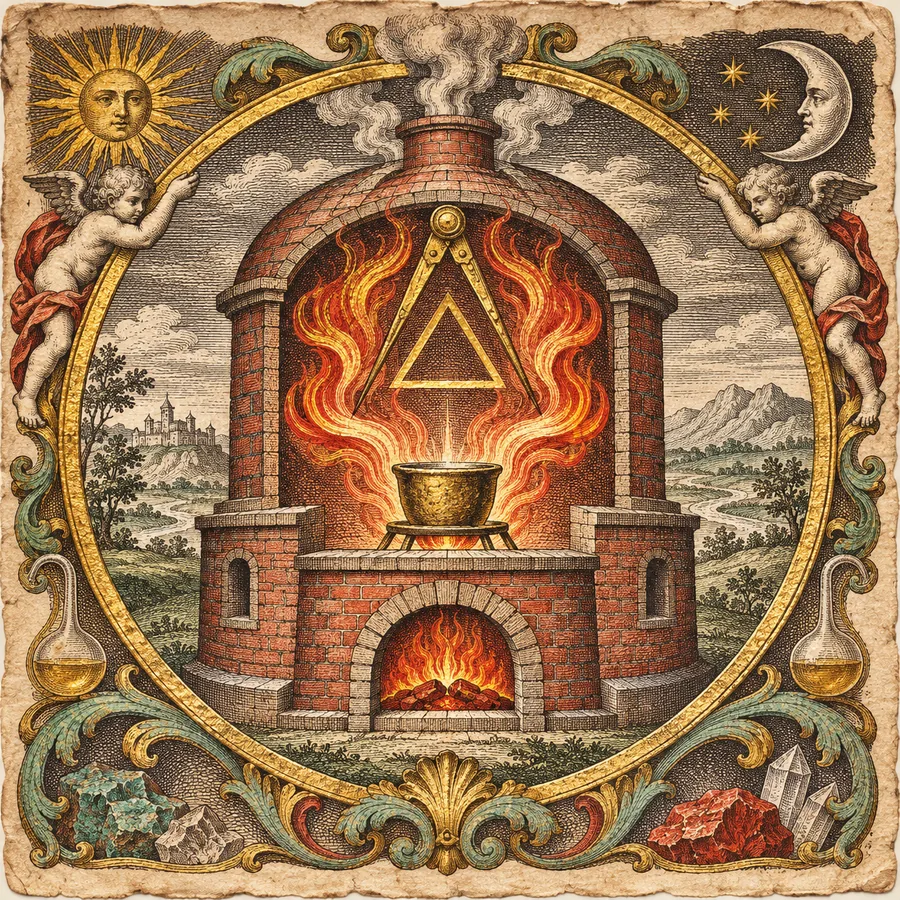
Fire (Ignis)
Chymical fire (Ignis), glyph 🜂, the hot-dry agent of calcination, solar-martial heat, and laboratory combustion.
🜂 · Chem: Δ / ΔH < 0- Chymical Order
- I · Four Elements & Quintessence
- Latin Term
- Ignis Caloris
- Unicode
- U+1F702
- Modern Chemistry
- Δ / ΔH < 0
- Planetary Sphere
- Sol / Mars
- Magnum Opus Stage
- Calcinatio
Fire, Latin Ignis and in fuller chymical usage Ignis Caloris, is the element whose standard glyph is the upward equilateral triangle 🜂 (U+1F702). It is at once the Aristotelian hot-dry simple body and the laboratory calor that consumes, calcines, and reveals metallic calces. Renaissance authors treat it as both instrument and principle.
I.Glyph Geometry, Unicode & Scribal Variants
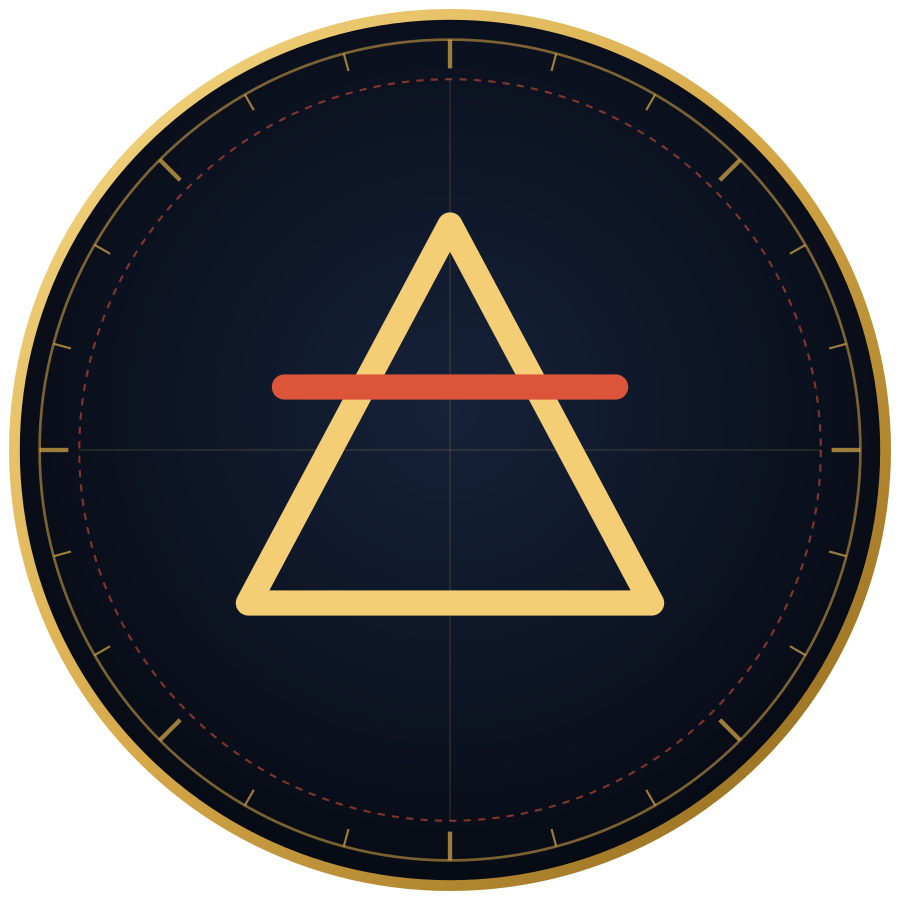
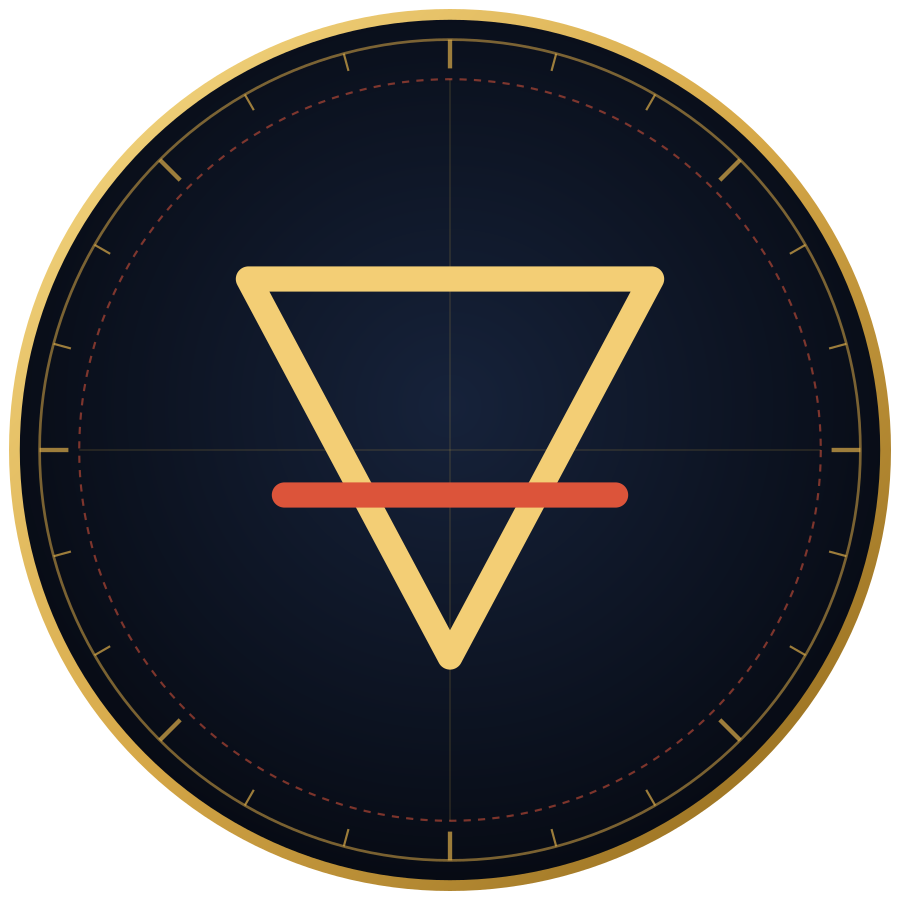
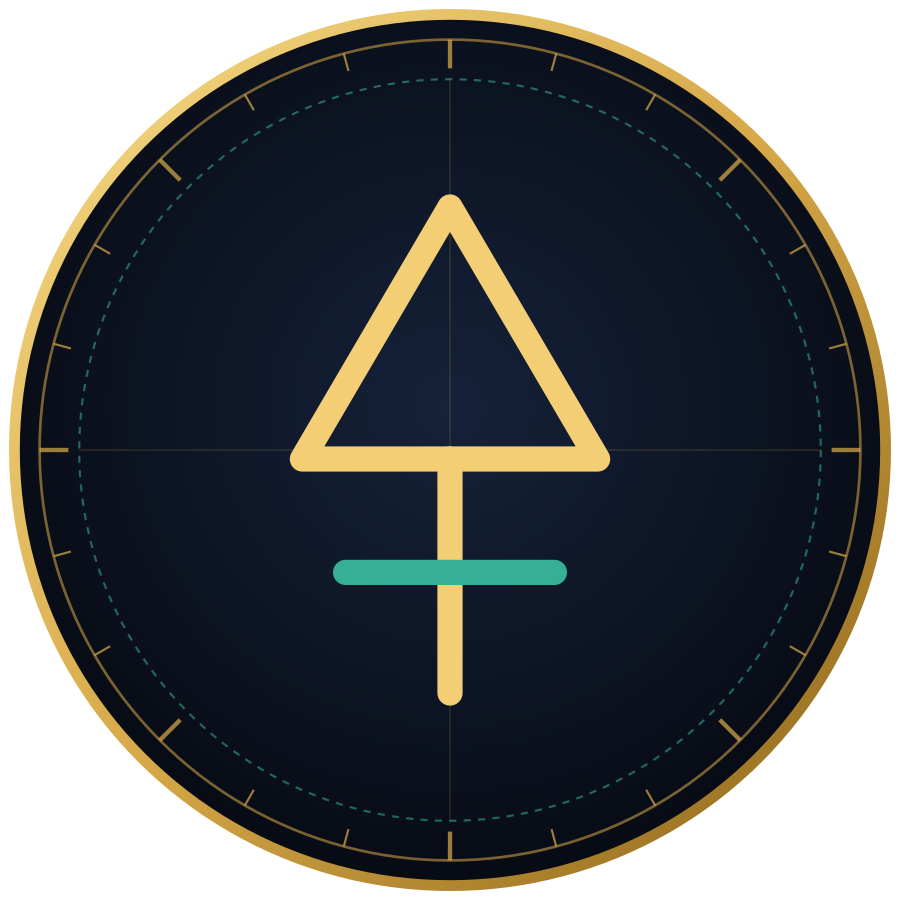
The fire glyph 🜂 (U+1F702) is an upward equilateral triangle of three strokes: a base and two sides meeting at the apex. Scribal copies seldom keep equal angles; bases tilt and apices blunt where the pen lifts. Lexica print it as an open outline, not a filled wedge. It is distinct from water's inverted triangle, from air (upward triangle with a cross-bar), and from earth (inverted triangle with a bar). A bare triangle is also unlike sulfur, which adds an internal or basal cross, and unlike the circled disk of Sol. Gessmann's Geheimsymbole classes Ignis Caloris with the elemental ciphers and records variants: a triangle tipped by a flame-stroke, or set over a furnace mouth. Newton's chymical notes use the plain triangle beside heat degrees and calcination steps, never substituting the solar roundel. The norm is three lines and an empty interior.
II.Laboratory Chymistry & Material Properties
In the workshop Ignis is managed heat in furnace, crucible, and cupel. Assayers burned charcoal in a wind furnace until a metal became a calx, or until lead in cupellation took up base metal and left a bead of silver or gold. The mark Δ stands for applied heat, and ΔH < 0 for the exothermic release of vigorous combustion; practitioners noted the same events as flame color, duration, and loss of weight in fumes. Native sulfur burns blue and acrid, saltpeter feeds incendiary mixes, and athanor coals hold a days-long digestion. Reguli collect under slag, vitriol reddens, and antimony can be driven to a glass. A fire too hard bursts glass; a fire too soft leaves the calx raw. Receipts therefore rank ignis lentus, mediocris, or fortis, each bound to a vessel and a span of time.
III.Hermetic Correspondence & Planetary Doctrine
Aristotle classes fire as hot and dry, opposite the cold wetness of water and paired with earth in dryness and with air in heat. That polarity organizes the four-element square used by medieval Latin commentators. Planetary assignment splits the same quality: Sol governs the tempered, generative heat that ripens gold, while Mars governs the sharp, sulfurous, martial fire that attacks and colors. Paracelsus relocates combustibility into his sulfur principle, one of the tria prima, so that flame becomes the sensible sign of sulfur rather than a free element floating above the world. Hermetic writers still keep the upward triangle as the emblem of ascent, volatility of spirit, and the active pole against lunar moisture. Ignis Caloris therefore names both the Sun's ripening warmth and Mars's devouring ardor, invoked when receipts demand solar digestion or a martial calcination.
IV.Historical Treatises, Papyri & Emblem Books
Greco-Egyptian technical papyri and the works associated with Zosimos of Panopolis already treat fire as the agent that tinctures metals and drives distillation in the kerotakis and alembic. Arabic authors, above all Jabirian and later Geberian Latin translations, grade furnaces and distinguish corrosive waters from the dry fire of calcination. Medieval Latin florilegia copy the upward triangle into element tables beside terra, aqua, and aer. Paracelsus and his editors make sulfur the bearer of inflammability and describe spagyric separations performed over graded heat. Emblem books fix the lesson for a courtly audience: Michael Maier's Atalanta Fugiens (1618) insists that the sage's fire is no kitchen blaze but a measured philosophical heat. Later collections circulated as the Basilica philosophica bind the glyph to receipts rather than to cosmology alone.
V.Role in the Magnum Opus & Laboratory Operations
Within the Magnum Opus, fire governs Calcinatio, conventionally the first gate. The vessel is set in ashes or sand over a graded furnace until the body loses moisture and volatile sulfur and falls to a powder or calx. Operators speak of a dry fire that opens the metal without melting it into a useless lump, and of iteration: calcine, dissolve, and calcine again. Philosophical calcination is sometimes set apart from the assayer's vulgar fire, yet both use the same triangle and seek a more open earth. Subsequent heats—digestion, sublimation, and the final coagulation—borrow the same Ignis but change its degree. A lentus fire incubates; a fortis fire punishes. Failure at this stage is described as burning the flower or fixing too soon.
VI.Transition to Modern Chemistry & Cultural Legacy
Eighteenth-century reform removed fire from the list of elements. Lavoisier accounted for combustion by oxygen and treated heat as caloric, a subtle fluid later abandoned; the flame ceased to be a simple body. Berzelius and his successors replaced pictorial glyphs with letter formulas, so the upward triangle survived mainly in historical plates. In present notation a triangle or the Greek delta still flags heat in a reaction scheme, and an enthalpy change below zero, written ΔH < 0, records an exothermic process—the quantitative heir of the old observation that some calcinations and combustions throw heat outward. Unicode 6.0 (2010) fixed the sign at U+1F702, ALCHEMICAL SYMBOL FOR FIRE, inside the block beginning at U+1F700. The code point keeps the triangle and does not restore fire as an element.
FAQ — Fire (Ignis)
What does the alchemical Fire (Ignis) symbol mean?
The upward triangle signifies the hot and dry classical element and the working heat of the furnace. In receipts it marks graded flame under a solar or martial regimen, especially at calcination, rather than a modern chemical species.
How is Unicode U+1F702 drawn, and what is it not?
U+1F702 is an open equilateral triangle pointing upward, three strokes with an empty interior. It is not air's barred upward triangle, water's inverted triangle, earth's barred downward triangle, or the circled disk of Sol.
How did laboratory fire differ from symbolic Ignis?
Laboratory fire was charcoal or wood heat in wind furnaces, crucibles, cupels, and athanors, judged by flame, time, and the calx or bead obtained. Symbolic Ignis named the hot-dry pole, Sol and Mars, and the gate Calcinatio, even when the same triangle stood in the notebook.
References
- Wikipedia: Classical element — Wikipedia Contributors (Wikimedia Foundation, 2026) · 2026-11-12The Wikipedia reference documents fire as one of the classical elements, with earth, water, air, and later aether, through which ancient cultures accounted for the complexity of matter.
- Die Geheimsymbole der Chemie und Medicin des Mittelalters — Gustav Wilhelm Gessmann (Verlag des Verfassers (Graz / München), 1899)Gessmann's Die Geheimsymbole der Chemie und Medicin des Mittelalters (1899) classes Ignis Caloris among the elemental ciphers and records workshop variants of the upward triangle.
- The Secrets of Alchemy & Unicode Standard Block U+1F700 (Alchemical Symbols) — Lawrence M. Principe / Unicode Consortium (University of Chicago Press / ISO/IEC 10646, 2013) · 2026-11-12Unicode places the sign at U+1F702 in the alchemical block from U+1F700, while Lawrence Principe's Secrets of Alchemy reads such glyphs as part of a continuous laboratory practice rather than bare allegory.
Related
Updated: · Editor: Tabula Chymica Editorial Archive