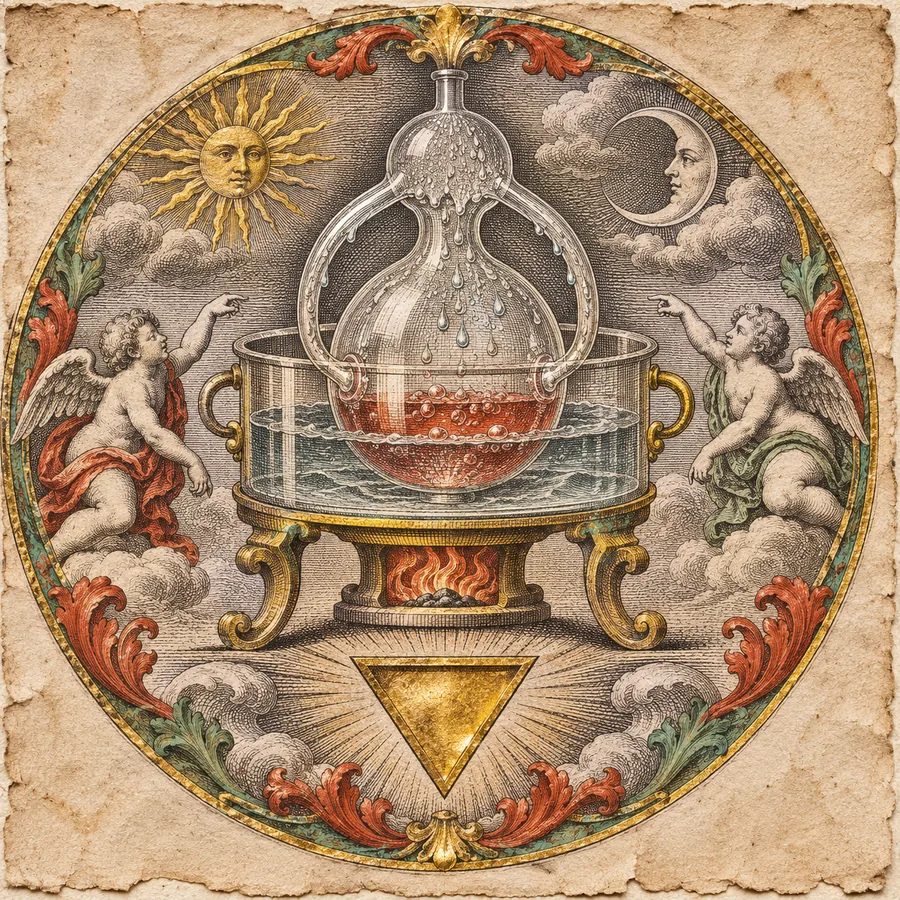
Water (Aqua)
Aqua (🜄) is the cold-moist classical element and the lunar solvent that begins Solutio in chymistry.
🜄 · Chem: H2O- Chymical Order
- I · Four Elements & Quintessence
- Latin Term
- Aqua Elementaris
- Unicode
- U+1F704
- Modern Chemistry
- H2O
- Planetary Sphere
- Luna
- Magnum Opus Stage
- Solutio
Aqua Elementaris (🜄) names ordinary water and the philosophical moisture of Renaissance chymistry. Its inverted triangle marks the downward course of the cold and moist, the liquor that loosens metals, salts, and calces. Under Luna it opens the Magnum Opus as Solutio, where solid figure yields to flux.
I.Glyph Geometry, Unicode & Scribal Variants
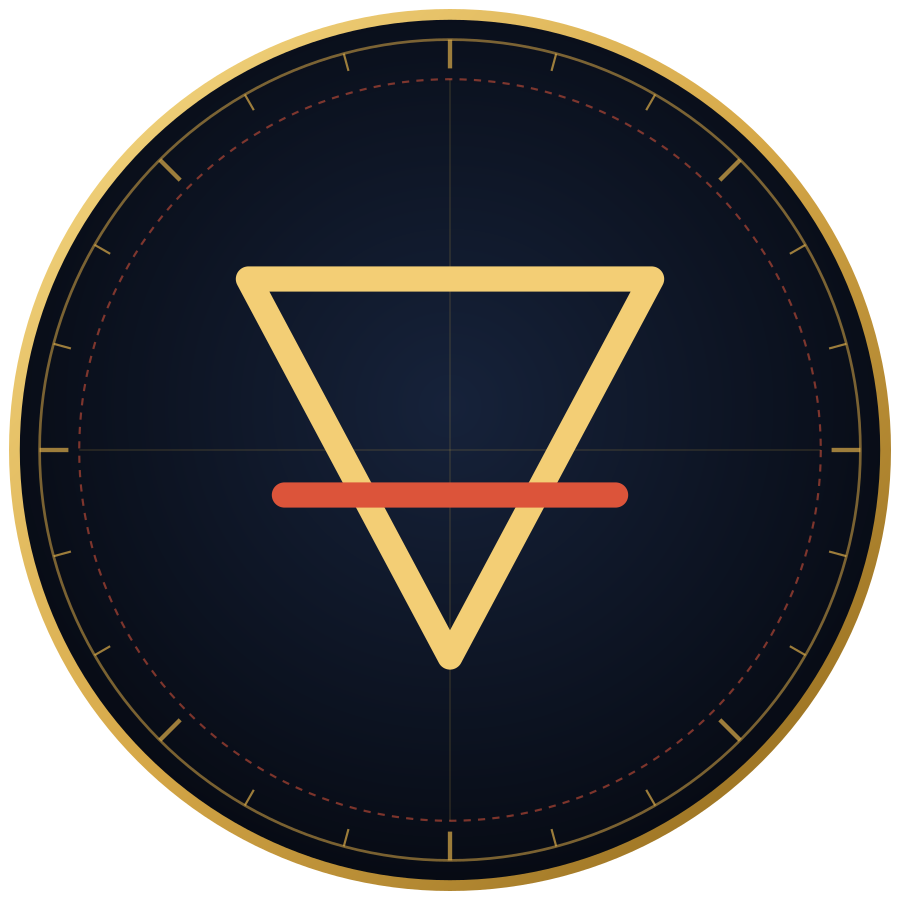
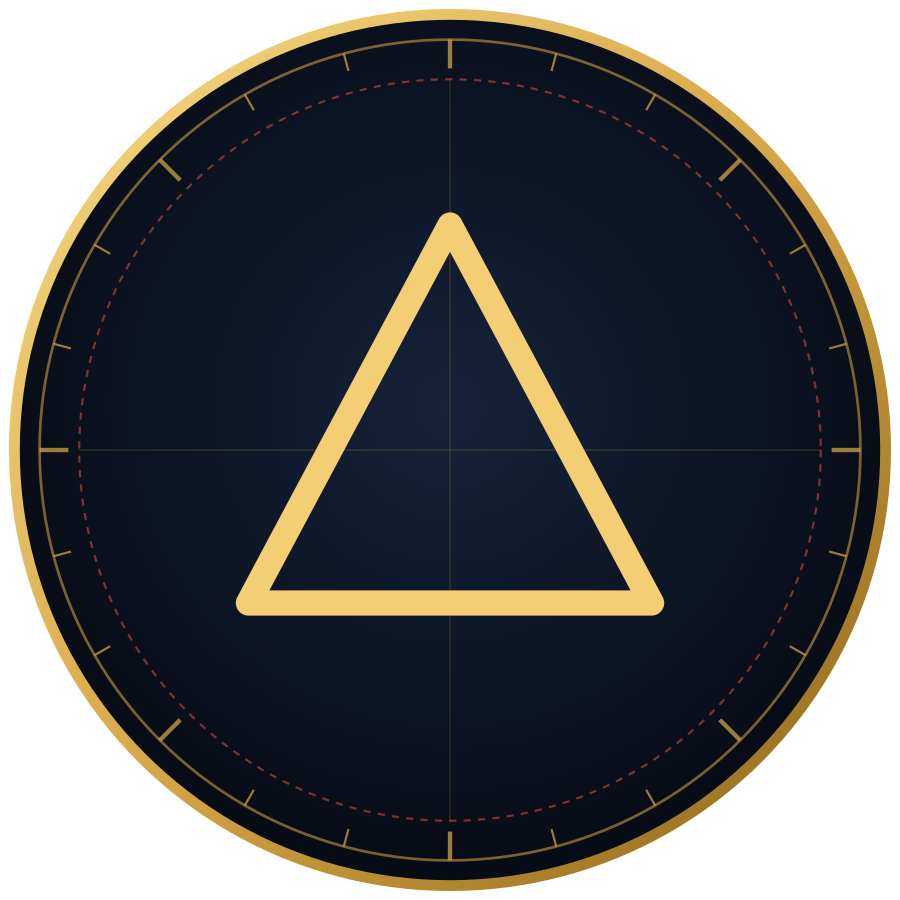
The sign 🜄 (U+1F704) is an inverted equilateral triangle: apex down, a level base above, and two diagonals meeting beneath. Scribes drew it in one pen motion or as three strokes and kept it small among the elemental quartet. Set over fire’s upright triangle, it forms the hexagram of contrary qualities. Gessmann’s Geheimsymbole lists the bare figure as Aqua elementaris; dots, crosses, or crescents mark pluvial, fontal, or mercurial waters. Newton’s notebooks usually give the plain inverted triangle to common water and compounded sigla to menstrua. Lookalikes must be excluded: U+1F702 is upright fire; a barred triangle may mean earth or salt; wavy lines are recipe shorthand for a liquor, not the element. The empty downward triangle diagrams gravity, wetting, and solution.
II.Laboratory Chymistry & Material Properties
In the workshop Aqua is the water of still, bath, and phial. Alembic and pelican parted phlegm from spirit and oil; the balneum Mariae kept heat gentle so liquors would not bump. Assayers washed ores and learned that elemental water does not part gold from silver: it wets, suspends slimes, leaches nitre and vitriol, and slakes calx, yet leaves gold, silver, and many sulfides untouched. Named sources—rain, dew, river, spring, distilled—mattered, since concealed salts changed flux and cupel color. Operators noted a stable boiling heat, expansion in frost, and oil’s refusal to mingle. Such notes are the core of what chemistry later writes as H2O, while chymists still called water the cold-moist matrix in which bodies lost their figure.
III.Hermetic Correspondence & Planetary Doctrine
Aristotle ranked water cold and moist, passive beside fire, able to receive form yet quick to lose its bounds. Renaissance chymistry set that pair under Luna: the Moon governs flux, silver, and the night sea, so Aqua is the lunar pole of the elemental cross. Paracelsus kept the four elements beneath the tria prima; water stayed the vehicle in which sulfur and salt open and mercury moves. The glyph stands opposite fire—down to up, moist to dry, solution to coagulation. Later esoteric manuals attach emotion and intuition to the element; operative manuscripts do not. They treat lunar water as humidity one can weigh and distill: it softens, putrefies, and makes the fixed volatile. Without it solar sulfur stays locked in the calx; in excess the work drowns in phlegm.
IV.Historical Treatises, Papyri & Emblem Books
Greco-Egyptian papyri already separate common water from named metal washes. Zosimos of Panopolis writes of divine waters that loosen bodies in the kerotakis, joining boiling practice to allegory. Arabic treatises in the Jabirian line, and the Latin Geber, treat aqua as distillation’s phlegm and as a solvent whose strength must be known before projection. Medieval Latin summae carry the split forward: aqua permanens, aqua vitae, and aqua fortis are different liquors. Paracelsus specifies fontal, pluvial, and distilled waters as both medicines and menstrua. Michael Maier’s Atalanta fugiens (1618) stages solution as washing and drowning, yet the epigram still implies a vessel at the fire. Later cipher tables, Gessmann’s among them, keep the elemental sign apart from the multitude of mineral acids.
V.Role in the Magnum Opus & Laboratory Operations
Solutio opens the Magnum Opus, and Aqua is its agent. Metal, calx, or imperfect stone is given to a measured water until the grain vanishes into liquor or black slime. The glass stands in ashes or a balneum, not in naked flame, until the solid figure fails—the death of the king. Solution is neither dry calcination nor the fractioning of the still; it is the wetting that makes both possible. Putrefaction follows in the same humid mass, then separation of phlegm, and only later coagulation, when the dissolved returns to a fixed body. Too little water leaves the metal unopened; too much gives a bath that will not congeal. Recipes therefore weigh Aqua against the body and repeat solution with coagulation until the moisture is ruled.
VI.Transition to Modern Chemistry & Cultural Legacy
Pneumatic chemistry removed water from the list of simple elements. Cavendish found that inflammable air burned with dephlogisticated air gives water; Lavoisier rewrote the fact as hydrogen united with oxygen. Berzelius’s formulas then set the composition as H2O and dropped the inverted triangle from analytical writing. The glyph remained in emblems and in scholarly transcription. Unicode’s Alchemical Symbols block, beginning at U+1F700, encodes it at U+1F704 so editions of Newton, Maier, and Gessmann need no private font. Historians following Principe and Newman read 🜄 operationally: a cold-moist solvent and the mark of Solutio, not a temperament. H2O and the old sign name one substance under two disciplines, stoichiometric quantity and the laboratory memory of dissolution.
FAQ — Water (Aqua)
What does the Water (Aqua) symbol mean in Renaissance chymistry?
The inverted triangle 🜄 marks the cold, moist element and the solvent used in Solutio. It names both ordinary water and the lunar humidity that opens solid bodies. It is not a sigil for the mineral acids, which received separate marks.
How is Unicode U+1F704 drawn, and which signs resemble it?
U+1F704 is an inverted triangle, apex downward and base level above. U+1F702 is the upright fire triangle and must not be confused with it. A barred triangle or a run of waves belongs to other hands and other liquors.
How did laboratory water differ from symbolic Aqua?
Workshop water was distilled, bathed, and weighed: it leached salts and slaked calx but did not dissolve gold. Symbolic Aqua named that same cold-moist action as the start of the opus. Acid waters such as aqua fortis were catalogued apart from the elemental sign.
References
- Wikipedia: Water (classical element) — Wikipedia Contributors (Wikimedia Foundation, 2026) · 2026-11-12The Wikipedia extract records water as a classical element in Greek, Indian, and Chinese systems and notes its later esoteric link with emotion and intuition.
- Die Geheimsymbole der Chemie und Medicin des Mittelalters — Gustav Wilhelm Gessmann (Verlag des Verfassers (Graz / München), 1899)Gessmann’s Die Geheimsymbole der Chemie und Medicin des Mittelalters (1899) classes the bare inverted triangle as Aqua elementaris and separates it from dotted or crossed waters.
- The Secrets of Alchemy & Unicode Standard Block U+1F700 (Alchemical Symbols) — Lawrence M. Principe / Unicode Consortium (University of Chicago Press / ISO/IEC 10646, 2013) · 2026-11-12Unicode places the water triangle at U+1F704 in the U+1F700 Alchemical Symbols block, while Principe’s Secrets of Alchemy reads such signs as records of laboratory practice rather than as mere mood-symbols.
Related

Updated: · Editor: Tabula Chymica Editorial Archive