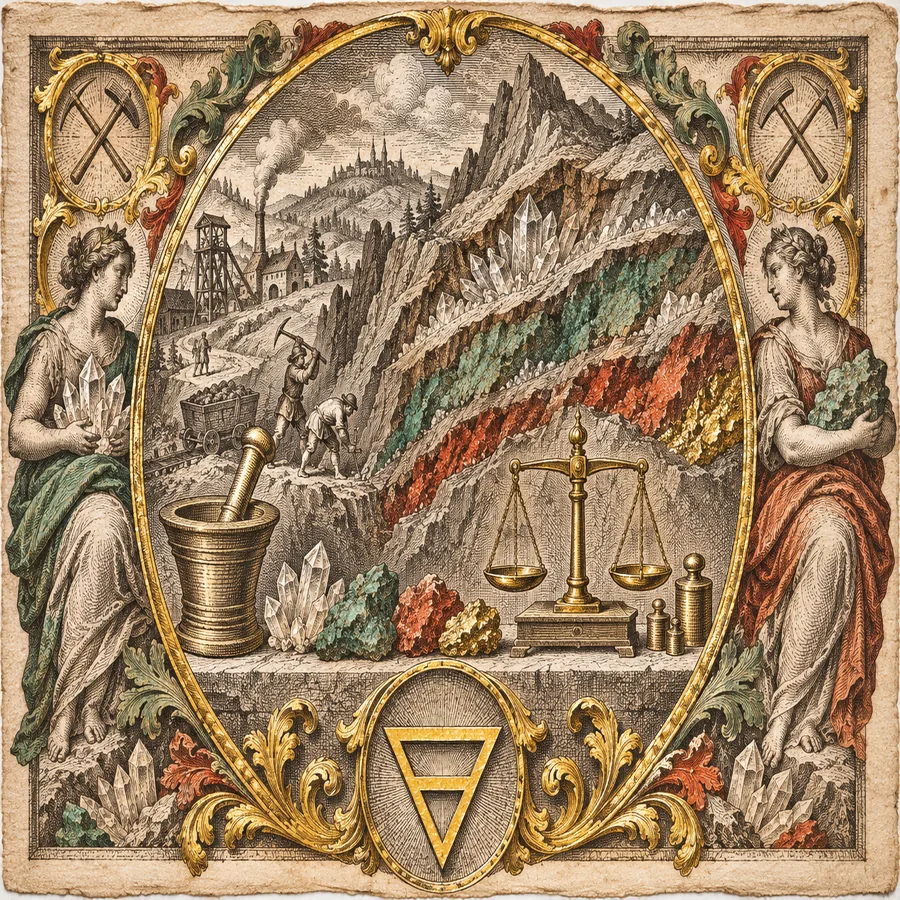
Earth (Terra)
Earth (Terra) is the cold, dry classical element of fixity, glyph 🜃, linked to Saturn and the opus stage of coagulatio.
🜃 · Chem: SiO2 / Caput Mortuum- Chymical Order
- I · Four Elements & Quintessence
- Latin Term
- Terra Fixa
- Unicode
- U+1F703
- Modern Chemistry
- SiO2 / Caput Mortuum
- Planetary Sphere
- Saturn
- Magnum Opus Stage
- Coagulatio
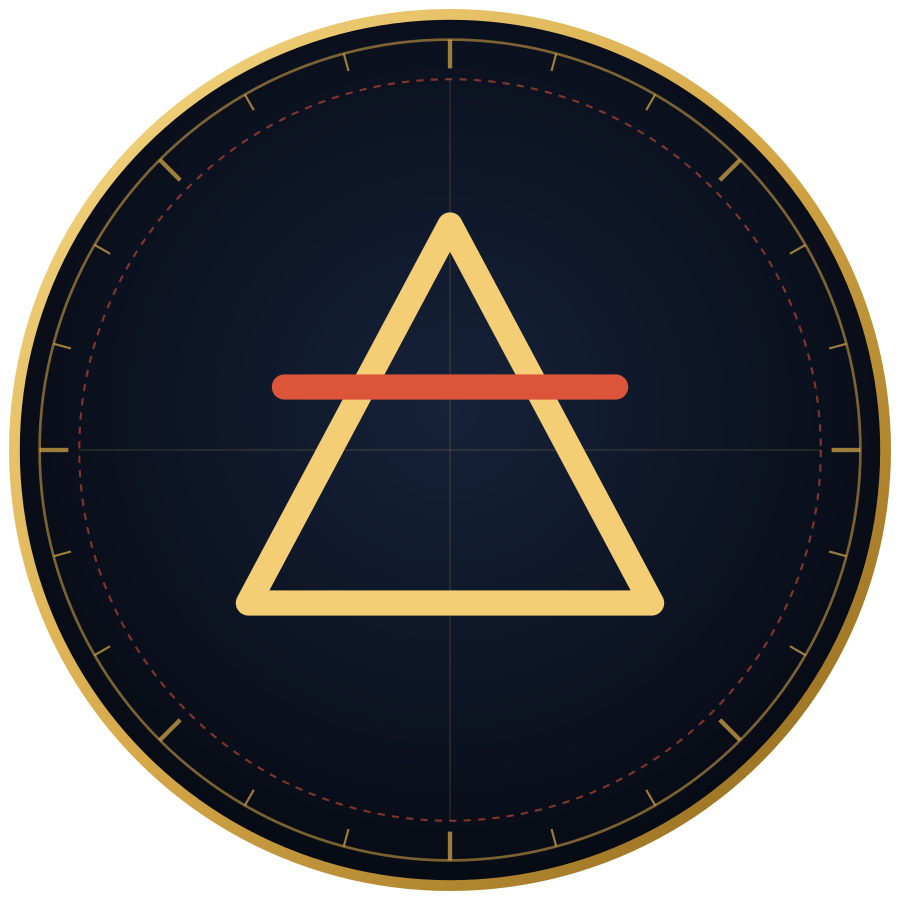
Earth, Latin Terra or Terra Fixa, is the cold and dry member of the four Aristotelian elements and the chymical principle of weight, opacity, and permanence. Its alchemical glyph 🜃 (U+1F703) is a downward triangle crossed by a horizontal bar. In laboratory practice the sign marked siliceous and other incombustible residues, later glossed as SiO2 or caput mortuum, and in the Magnum Opus it governed coagulatio under Saturn.
I.Glyph Geometry, Unicode & Scribal Variants
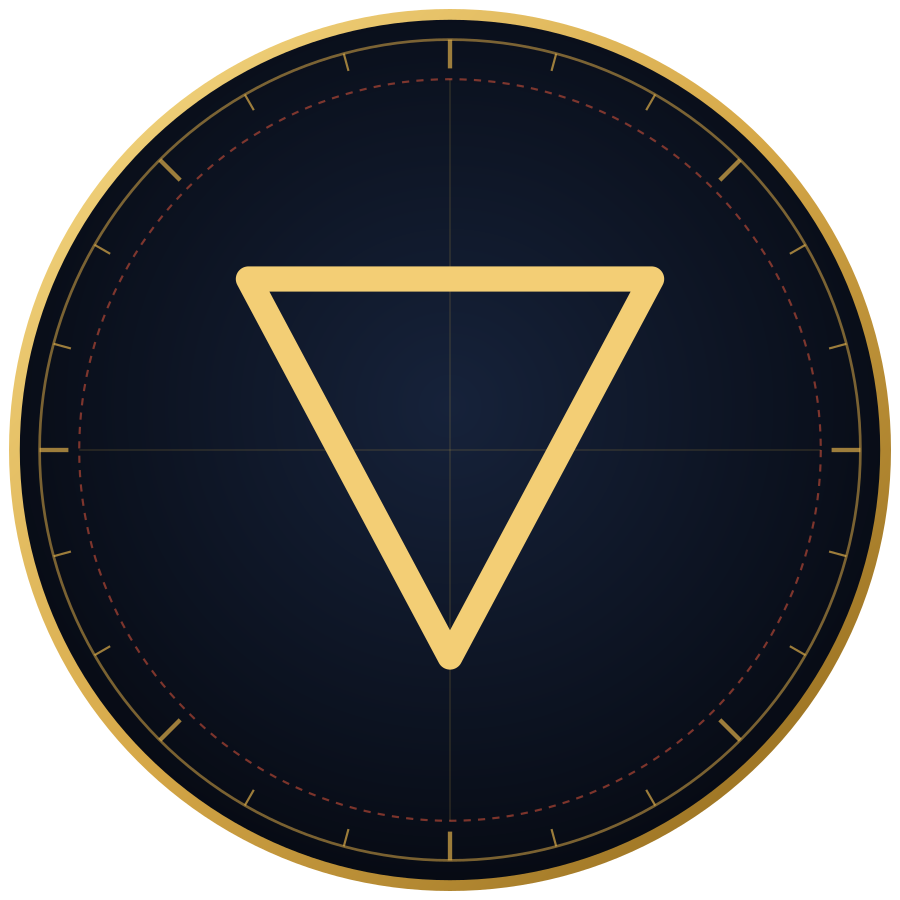
The earth sign is built from the water triangle inverted: three strokes meet as a downward point, and a single transverse bar cuts the upper third, converting fluidity into arrested weight. Scribes drew the bar either as a full chord touching both sloping sides or as a shorter dash floating inside the triangle; both readings appear in early modern symbol lists. Newton’s alchemical manuscripts and the plates digested by G. W. Gessmann in Die Geheimsymbole der Chemie und Medicin des Mittelalters (1899) show the bar sometimes thickened or doubled when the scribe wished to stress Terra Fixa against mere earthy impurity. The geometry must be kept distinct from the plain downward triangle of water, from the salt circle-and-bar, and from the crossed circle sometimes used for antimony or for the world. In hurried marginalia the bar can drift toward the apex and begin to resemble a barred arrow; careful copies keep the bar parallel to an imagined baseline and well above the point. Unicode U+1F703 standardizes the crossed inverted triangle as ALCHEMICAL SYMBOL FOR EARTH, preserving the contrast with U+1F704 water and with the later planetary glyphs that borrow triangles for other qualities.
II.Laboratory Chymistry & Material Properties
In the workshop Terra named what remained when volatile spirits, oils, and waters had been driven off. Assay furnaces, cupels, cementation pots, and the glass body of the alembic all left an earthy caput mortuum: a fixed, often reddish or grey powder that would not rise in gentle heat. Siliceous matter—sand, flint, quartz, and the glassy scoria of metallurgical slag—supplied the clearest physical model later identified with SiO2. Such earth neither dissolved readily in ordinary menstrua nor inflamed; it vitrified only at strong fire and served as a container, a flux moderator, or a dead head sealing a retort. Mineral sources included river sand, calcined pebbles, bole and other clays, and the incombustible residue of vitriol or of martial preparations once their acidic and metallic portions had been separated. Operators recorded color, weight, and refusal to sublime. A white fixed earth might be washed and reverberated toward a philosophical salt; a dark caput mortuum was more often rejected or reused as a bath and lute. The practical test was behavioral, not elemental purity in the modern sense: if the body stayed in the bottom of the vessel through repeated cohobations, it was earth.
III.Hermetic Correspondence & Planetary Doctrine
Aristotle assigned earth the primary qualities cold and dry, so that it occupied the center of the cosmos and received the other elements as its container. In chymical theory that pair became fixity: the power to hold form against fire and against the dissolving moist radical. Paracelsian writers sometimes folded earth into the tria prima by treating salt as the earthly principle of body, while still retaining Terra as the gross matrix from which salt must be extracted. Planetary mapping placed this office under Saturn, the slow, heavy, melancholic star whose metal is lead and whose operations are coagulation, putrefaction, and long decoction. The polarity is therefore with fire and with air: earth quenches exuberant sulfur and gives bound to mercurial volatility. Symbolically it is the tomb and the field at once—caput mortuum as death of the volatile, and Terra Fixa as the ground in which the seed of metals can be buried until it firms. Hermetic commentaries warn against confusing this philosophical earth with garden soil; only the washed, calcined, or vitrifiable earth participates in the work.
IV.Historical Treatises, Papyri & Emblem Books
Greco-Egyptian technical papyri and the later Corpus attributed to Zosimos already speak of earths, ashes, and fixed residues alongside distillation, though they do not yet fix the crossed-triangle glyph as a universal standard. Medieval Arabic mineralogical and alchemical treatises, transmitted in Latin as the Geberian corpus and related books of furnaces, classify earths by color, fusibility, and behavior under the fire of assaying. Latin symbol lists from the later Middle Ages and the sixteenth century stabilize 🜃 as Terra. Paracelsus and his editors use earth both as an element and as a pharmaceutical matrix—bolus, terra sigillata, and the dead head of chemical preparations—while insisting that the true arcana are separated from gross feces. Emblem books make the same distinction visual. Michael Maier’s Atalanta Fugiens (1618) stages earth as the heavy partner that must be joined to a fugitive volatile, and the discourse tradition around the Basilica Philosophica and related Rosicrucian-era compilations repeats Terra Fixa as the body that survives calcination. Gessmann’s 1899 catalogue then gathers these manuscript variants, separating Terra, Terra Fixa, and caput mortuum as related but not identical signs in medieval and early modern medico-chymical notation.
V.Role in the Magnum Opus & Laboratory Operations
Within the sequence of the Magnum Opus, earth is the patient of coagulatio and the product that proves coagulatio has occurred. After solutio has opened a body and after distillation or sublimation has lifted its spirit, the artist returns the volatile upon the feces or upon a prepared fixed salt so that the flying part is compelled to take body again. The operation is recognized when a liquid or a fume thickens, grains, or vitrifies and will no longer ascend at the same degree of heat. Saturnine regimens—slow heat, sealed vessels, long decoction—favor this binding. Caput mortuum may be the discarded gross earth that never re-enters the work, or, in stricter readings, the black or reddish fixed matter that is washed and recombined until it becomes the white and then the red earth of the stone. Laboratory order therefore alternates elevation and fixation: earth is not a single ingredient added at the start but the recurring state of being fixed. Success is judged by the residue’s constancy under renewed fire, not by the mere presence of sand or clay in the cucurbit.
VI.Transition to Modern Chemistry & Cultural Legacy
Lavoisier’s reform of chemical nomenclature and the nineteenth-century notation associated with Berzelius retired elemental earth as a substance. What artisans had called earths were resolved into distinct oxides and salts; the siliceous earth that resists acid and vitrifies became silicon dioxide, SiO2, while many red-brown caput mortuum residues of vitriolic and martial work were recognized as iron oxides used later as pigments. The alchemical sign no longer denoted a chemical species in the periodic sense. Historians of science, notably in the line of Lawrence Principe and William R. Newman, read Terra instead as an operational category inside a coherent premodern laboratory culture. Unicode preserved the graphic inheritance: the Alchemical Symbols block beginning at U+1F700 encodes U+1F703 as ALCHEMICAL SYMBOL FOR EARTH, fixing the crossed inverted triangle for digital scholarship without implying that SiO2 exhausts the historical concept. Modern chemistry thus explains the materials; it does not replace the chymical distinction between volatile and fixed.
FAQ — Earth (Terra)
What does the Earth (Terra) symbol mean in chymical texts?
The glyph 🜃 marks the cold, dry element and, more narrowly, fixed earth or Terra Fixa: matter that stays in the vessel when spirits are driven off. It signals weight, permanence, and the Saturnine side of the work rather than a single modern compound.
How is Unicode U+1F703 drawn, and how does it differ from water?
U+1F703 is a downward-pointing triangle crossed by a horizontal bar. Water is the same triangle without the bar. Scribal copies vary the length and height of the bar but keep it parallel to the base and clearly above the point.
Was Terra only a symbol, or did it name real laboratory materials?
Both. Operators applied the name to sand, flint, clays, vitrified slag, and the incombustible caput mortuum left after distillation or calcination. The symbol organized those fixed residues; it was not a purely literary emblem detached from the furnace.
References
- Wikipedia: Earth (classical element) — Wikipedia Contributors (Wikimedia Foundation, 2026) · 2026-11-12The Wikipedia reference records Earth as one of the classical elements, in four-element systems standing with air, fire, and water.
- Die Geheimsymbole der Chemie und Medicin des Mittelalters — Gustav Wilhelm Gessmann (Verlag des Verfassers (Graz / München), 1899)Gessmann’s Die Geheimsymbole der Chemie und Medicin des Mittelalters (1899) classifies Terra Fixa among medieval medico-chymical signs and distinguishes related earth and caput mortuum glyphs.
- The Secrets of Alchemy & Unicode Standard Block U+1F700 (Alchemical Symbols) — Lawrence M. Principe / Unicode Consortium (University of Chicago Press / ISO/IEC 10646, 2013) · 2026-11-12Unicode places EARTH at U+1F703 in the U+1F700 alchemical block, while Principe’s Secrets of Alchemy treats such earths as operational categories of premodern chymistry rather than failed modern elements.
Related
Updated: · Editor: Tabula Chymica Editorial Archive